How to Build a Generative AI Application: Step-by-Step

Everyone is talking about generative AI like it’s a plug-and-play miracle. You just type a prompt, get a product, done. It’s not. 

That oversimplified version of the story is exactly why so many AI projects stall out somewhere between an exciting demo and a product real users can depend on. 

The truth is messier, more interesting, and honestly more useful to understand before you start building. You can’t simply make decisions about: 

  • What real mistakes to avoid
  • What real technical hurdles trip up even experienced developers? 
  • Should you fine-tune a model or use one off the shelf? 
  • How do you stop your chatbot from confidently making things up? 
  • What happens when your app works beautifully for ten users but falls apart under real traffic?

If you have recently typed how to build a generative AI application and could not find the right answers, you have landed in the right place. 

Regardless of whether you are a generative AI developer, a product manager, or a business owner, we can help you nail it. 

In this write-up, we will share the nine easiest steps to build a generative AI application, along with its real challenges and the do’s and don’ts. 

Let’s get into it.

TL;DR

To build your own generative AI application, you should start with a problem statement. After that, you will first choose a reliable model. From there, you research existing use cases and choose among an API, fine-tuning, or training from scratch. You design a clean data pipeline, craft and test prompts carefully. If possible, go for a lean first version, and test rigorously for accuracy and bias before launch. Once you are satisfied, you are good to go live and do maintenance as needed. Note: Unpredictable outputs, hallucinations, rising API costs, latency issues, data privacy concerns, bias, and scaling are challenges. DIY can be a bit tricky. If you want to skip months of trial and error, partnering with an experienced AI development company like Trango Tech is the way forward. 

Key Takeaways

  • Building a generative AI application needs a solid approach, experience, and expertise. Based on that, you will ideate, design, develop, and update as needed. 
  • Unreliable outputs, hallucinations, privacy issues, and biases are certain problematic aspects of this. You have to go the extra mile to deal with them and leave no stone unturned in terms of accuracy. 
  • Building a generative AI application costs anywhere from $15,000 to $500,000. It can go up or down based on model strategy, team location, and ongoing usage. 
  • In the end, you have to partner with an experienced AI development company. They will provide you with the right guidance and support. It is going to save months of costly trial and error

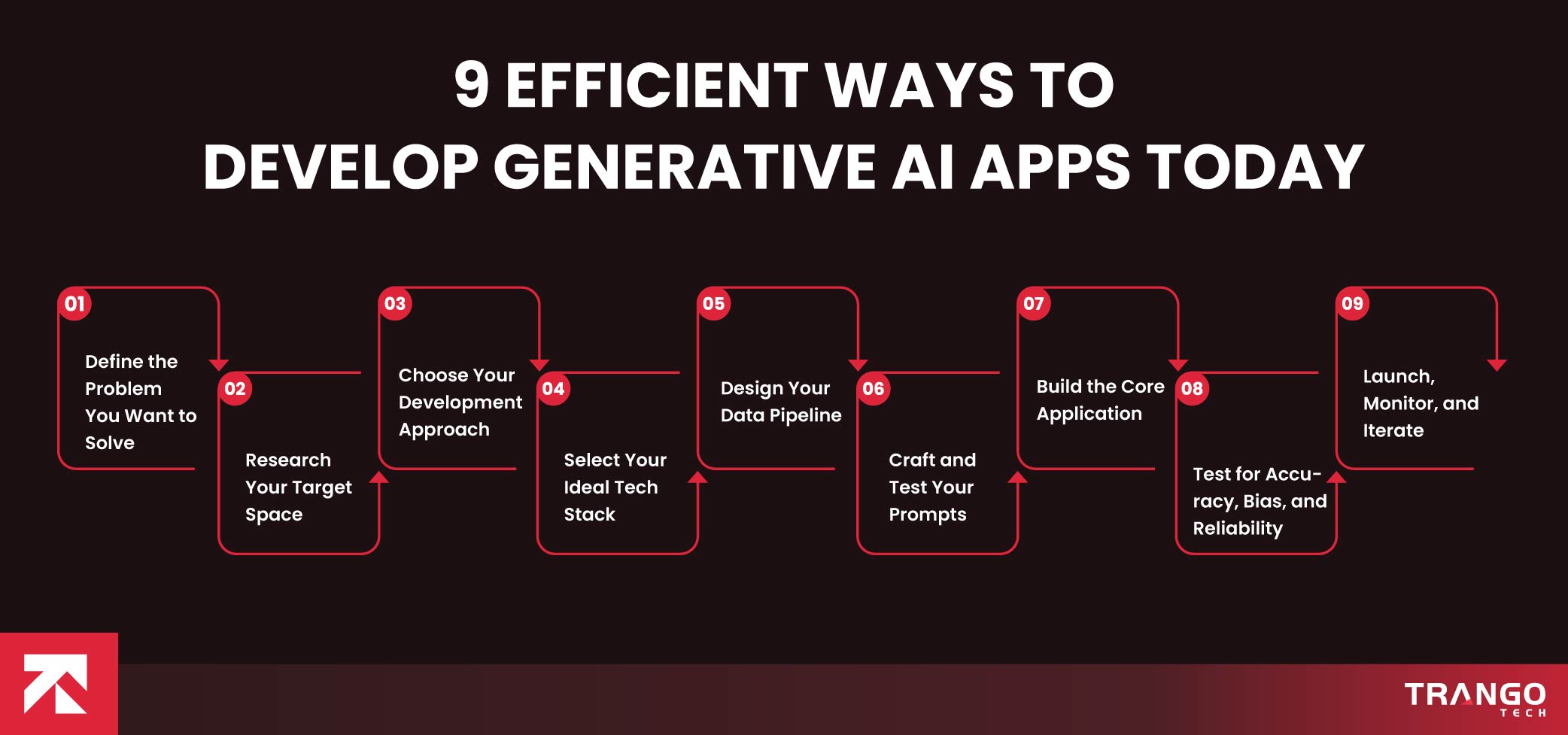
9 Efficient Ways to Develop Generative AI Apps Today
9 Efficient Ways to Develop Generative AI Apps Today

Generative AI apps are everywhere right now, but finding development experts who actually know how to build them well is still pretty rare.

Most of the companies simply chase the hype. They have zero real-world projects done before. 

However, we have been mastering this since 2023. To date, our seasoned individuals have shipped 200+ applications, and dozens are already in the dev pipeline. 

Reflecting on that experience, we have shared below a proven development process for generative AI applications. 

Step 1: Define the Problem You Want to Solve 

To develop an AI app, you have to first start with a problem that really exists. It can be anything; healthcare providers might automate medical imaging, while others seek it for advanced CX. 

Apart from that, you should figure out exactly what your users need before you think about models, APIs, or architecture. 

Be quite clear about all of it. Your exact purpose should be neither vague nor out of scope, as needed. 

You can either summarize documents, generate images, write code, or answer customer questions. 

Each of these applications of generative AI needs a different setup, and skipping any is why so far up to 95% of projects fail. 

Step 2: Research Your Target Space

You should thoroughly research the market you are about to target. Ensure you know what similar AI solutions already exist. 

Find out what they are good at, or what they lack. Primarily, the use of Generative AI applications is diverse. 

It spans content creation, customer service, healthcare diagnostics, software development, and design tools. 

Study how similar products work, note their weaknesses, and figure out where your app could genuinely do better. 

Remember, never ever skip the research. It may look like doing something extra, but it will save you from wasting your time and effort on something that already exists.

Step 3: Choose Your Development Approach

When it comes to developing an AI, engineers have mainly three different ways forward. For instance, they can: 

  1. Use an existing model via API. 
  2. Fine-tune a pretrained model 
  3. Train a model from scratch 

What we suggest to most businesses is to use the Google Generative AI App Builder or API approach. It is quick and easy so that you get to test your idea first. If it works, you are good to go ahead. 

Step 4: Select Your Ideal Tech Stack 

Remember that the technologies you choose to work with will make or break your success throughout. 

Now is the time to pick the best backend framework, database, and hosting setup. 

Furthermore, pulling your information from documents or a knowledge base beforehand requires separate frameworks. For example, use Pinecone or Chroma for RAG. 

Apart from that, avoid building everything manually.  If needed, go for low-code options as well. 

They are good for building search and conversational apps quickly. Choosing the right tools here saves you rework later.

Step 5: Design Your Data Pipeline

Regardless of whether you have to train or not, the pipeline is paramount at any cost. It is also important to keep your data clean and flowing through your app. 

Before you proceed, see what data users provide, what data your app retrieves, and how that data gets formatted. 

There should be clear-cut SOPs to ensure clean, consistent data reaches any model. If not, this will be the most common cause of a production break.

Step 6: Craft and Test Your Prompts

This is so far the most important yet ignored step in the development of an AI application.

You should give it more attention than it deserves. Give it a prompt to see how it functions. 

One should see if there is reliable output quality. If not, they should enhance it as much as possible. 

During this quality check, one should write clear instructions and add examples of ideal responses. 

Then test how the model handles unusual or off-topic input. A well-designed prompt often matters more than the underlying model choice.

Step 7: Build the Core Application

When you feel ready to move forward, let’s get into the actual AI product development. 

Your AI engineering will now connect your frontend to your backend, wire up your API calls, and create a working prototype. 

Remember to keep the first version lean. Add loading states, error handling, and fallback behavior for when the model produces something unusable. 

Step 8: Test for Accuracy, Bias, and Reliability

Initial tests you did were about the models; now it’s time to test the system as a whole. You should leave no stone unturned in terms of quality checks. 

Since outputs vary, they aren’t always predictable; ensure you remain vigilant throughout this journey. 

Note that there are certain quick checks we would recommend based on personal experience. 

It spans assessment for hallucinations to see if the existing model states something false with total confidence. 

Act as the independent user first and then check your AI. Don’t forget to omit any bias, primarily for niches like hiring or healthcare. 

Last but not least, embed guardrails like content filters, where needed. Given the importance of data, a human should review before any response. 

Step 9: Launch, Monitor, and Iterate

In the end, deploy your AI system on the intended platform, which can be an Apple Store, Play Store, or the web. 

Set up logging so you can see what users ask for and how the model responds from time to time. 

Given that data, you may use it to further enhance your prompts, adjust your model choice, and decide what to build next. 

Also read: Explore 2026 AI development costs, unexpected line items, and ways to streamline your spend.

Challenges In Building a Generative AI Application
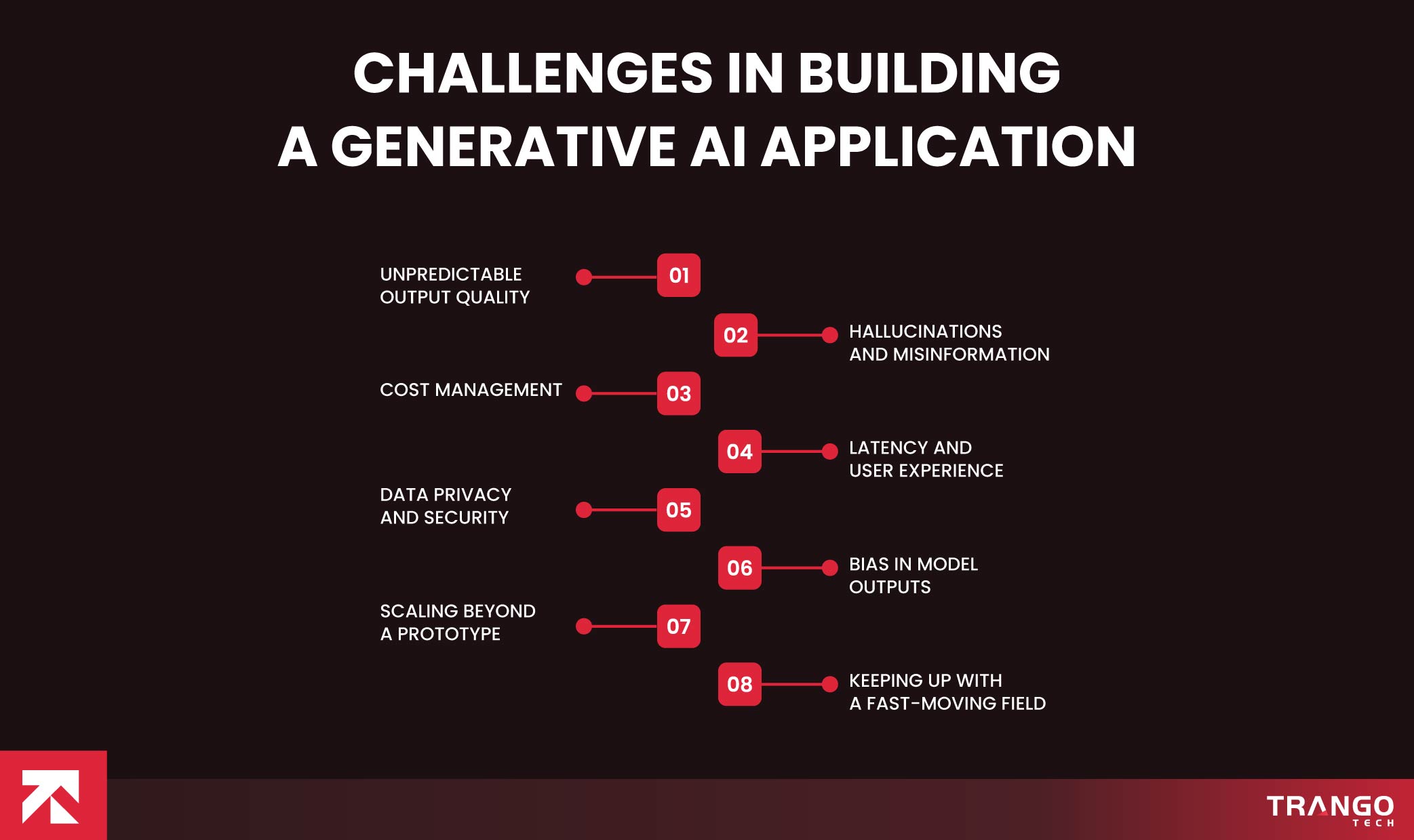
Challenges In Building a Generative AI Application

Though the process given above might look easy to read, it can be tricky once you start doing it. 

No matter how good you do with a prototype, if you can’t build a genuinely reliable product, it is worth nothing. 

In order to help you ace it, we have shed light on the challenges that may arise while you are up to develop an AI app. 

Important: those who grasp them and keep them in check throughout have no chance of failure. 

  • Unpredictable Output Quality

Generative AI isn’t always consistent, unlike traditional software. It’s very hard to do quality control. If you write one test case and say That’s enough, you will be in trouble, because something will be different every now and again, and you’ll need to test a variety of inputs.

  • Hallucinations and Misinformation

Sometimes models give information that may sound believable but isn’t. 

This is a huge issue for any application where facts, medical, legal, or money advice are involved. 

There are more than just the raw results to consider when creating a generative AI app for these areas. 

You need to add fact-checking features, or you need a human in the middle.

  • Cost Management

API calls are not free and cost more as the number of calls. There are teams that do not plan their costs and end up being surprised at the actual traffic. 

Record and track the use of tokens at the beginning, keep the calls to the more expensive model calls at the most suitable places, and store the repeated calls at the optimum places.

  • Latency and User Experience

Creating a generation will take time, and users will feel the delays. For a live product, it’s too long; it’s 8 seconds or 10 seconds. 

Having some streaming output as it is generated will be of great assistance here, even if the overall processing time is the same.

  • Data Privacy and Security

Many uses of generative AI involve handling sensitive user information – whether it be personal data, business documents, or proprietary code. 

Policies on sharing data with third-party APIs, keeping it in the system for an extended period, and using the data for further training on the models are important. 

This is a poor way to go. Your legal and trust issues are soon to follow. The better you stay safe from it. 

  • Bias in Model Outputs

Models learn from data containing real-world biases, and biases may be present in generated content. 

It is a crucial factor in aspects such as job hiring, loan acceptance, health care advice, and much more. 

These are detected before they can harm the system due to routine auditing of the outputs and through a variety of test cases.

  • Scaling Beyond a Prototype

A demo that works for 10 people does not necessarily work for 10,000. Infrastructure that seems to be okay when tested can crumble under normal use. 

Don’t encounter surprises like rate limits, queues, and graceful degradation; plan for them!

  • Keeping Up With a Fast-Moving Field

New models, techniques, and tools are developed here on a regular basis. Best practices today must be reconsidered in 6 months. 

Building a gen AI app does not just mean building the first MVP; it’s something that needs to be learned and rethought over and over in relation to technology choices.

Bonus read: Check out our list of the best AI development companies for businesses of all sizes in 2026.

Do’s and Don’ts of Generative AI Application Development

Hope the challenges we have discussed have made things easier for you. For your further ease, we are about to discuss do’s and don’ts to assist with this. 

Just spare a few minutes and check out actionable do’s and don’ts. Keep this nearby as a gut-check. 

For those who keep asking “how to develop AI applications”, this won’t replace careful planning. However, you can avoid a lot of the common mistakes before they cost you time or money.

Area Do Don’t
Planning Define a specific problem before choosing a model Start building without a clear use case
Model Selection Start with an existing API for speed and flexibility Train a model from scratch unless you truly need to
Prompt Design Test prompts against edge cases and unusual input Assume one well-written prompt will always hold up
Data Handling Keep your data pipeline clean and well-structured Feed messy or inconsistent data into the model
Accuracy Add fact-checking layers for sensitive use cases Trust model output blindly in high-stakes areas
Bias Audit outputs regularly across diverse scenarios Assume the model is neutral by default
Cost Track token usage and cache repeated queries Ignore usage costs until the bill arrives
Performance Use streaming responses to improve perceived speed Make users wait on a blank screen for output
Security Set clear policies on data retention and third-party use Send sensitive user data without a privacy plan
Scaling Plan for rate limits and load before you need them Wait until traffic spikes to think about infrastructure
Iteration Treat launch as the start, not the finish line Assume version one is the final version

Get Your Own Generative AI App Now!

Building a generative AI application takes the right approach, experience, and expertise to nail it. With all that in hand, the process ahead becomes much easier. 

Just find a problem you are up to solve, design, develop, deploy, and then maintain it from time to time as needed. 

Hallucinations, cost overruns, scaling issues, and bias may arise, but it is up to your expertise and how well you address them. 

Taking all that into account, business leaders all over prefer to hire a generative AI development firm. 

A reliable tech partner like Trango Tech will take care of all your technical needs. From prompt engineering to infrastructure scaling, we do it all. 

Luckily, we already have 200 generative AI products and can do yours too. Our diverse industry experience is also very rare to find in the market. 

If you are serious about turning your generative AI idea into a real, working product, you don’t have to figure it all out on your own. 

Let Trango Tech bring the years of hard-earned lessons to your project, so you can skip the struggle and get straight to the results.
Top 10 Generative AI Use Cases for Enterprise: A Strategic Guide for US Entrepreneurs

As per a recent MIT study, approximately 95% of enterprise generative AI pilots fail before reaching production. The main reason is not the model quality itself but the firm’s knowledge gaps, poor system compatibility, and integration gaps.

Most generative AI use cases for enterprise models are tested in SandBox, but Trango Tech focused on workflow and structural automation that lead to a 95% success rate of AI use cases for business.

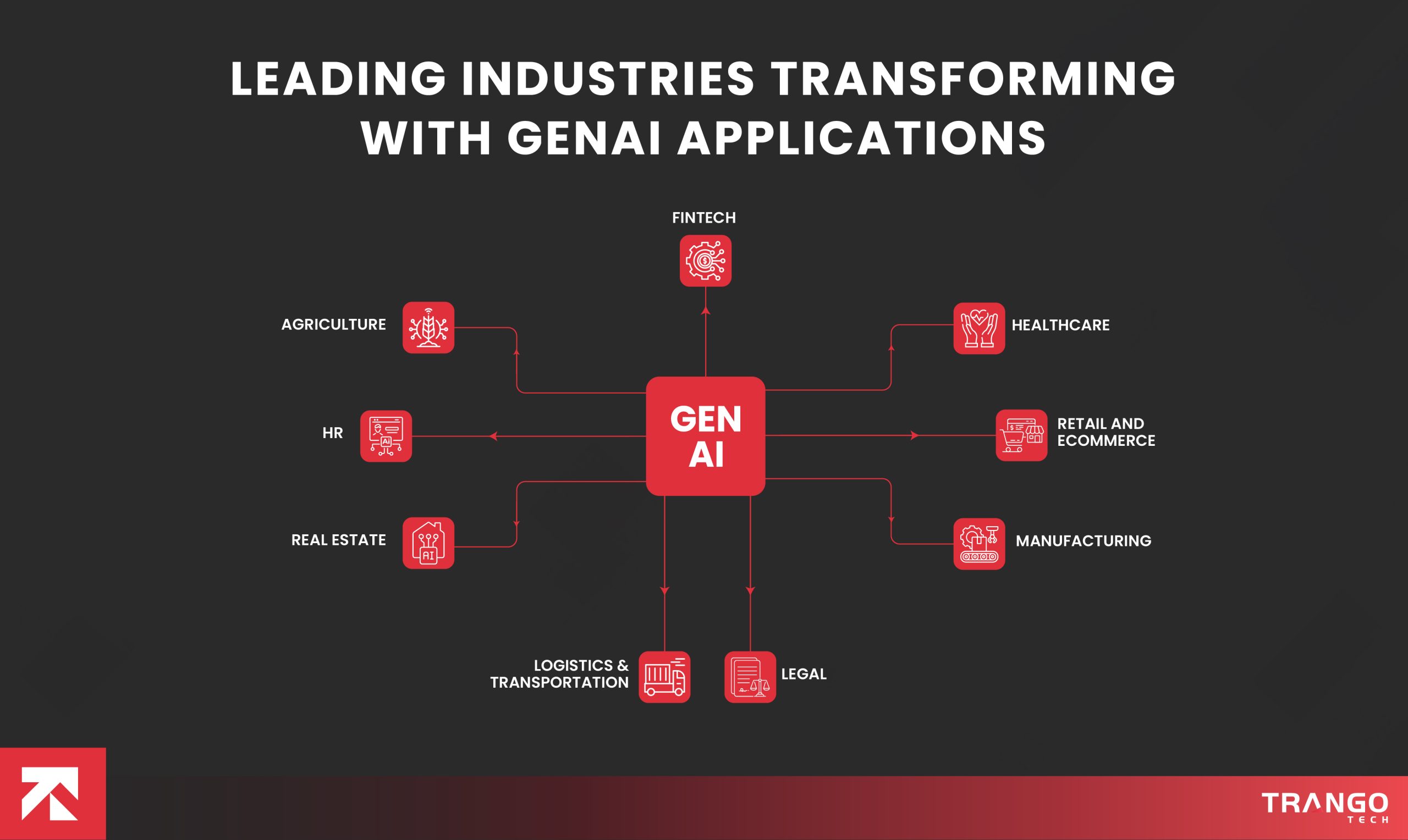
In 2024, industries like Finance, healthcare, retail, eCommerce, manufacturing, logistics, real estate, HR, agriculture, and legal companies are shifting from mere experiences to production ready GenAI enterprise AI use cases.

Top generative AI examples include the development of custom LLM, RAG pipeline, AI agent, AI chatbot & copilot, LLM fine-tuning, generative AI integration, AI consulting & GenAI strategy services, and multimodel AI deployment. 

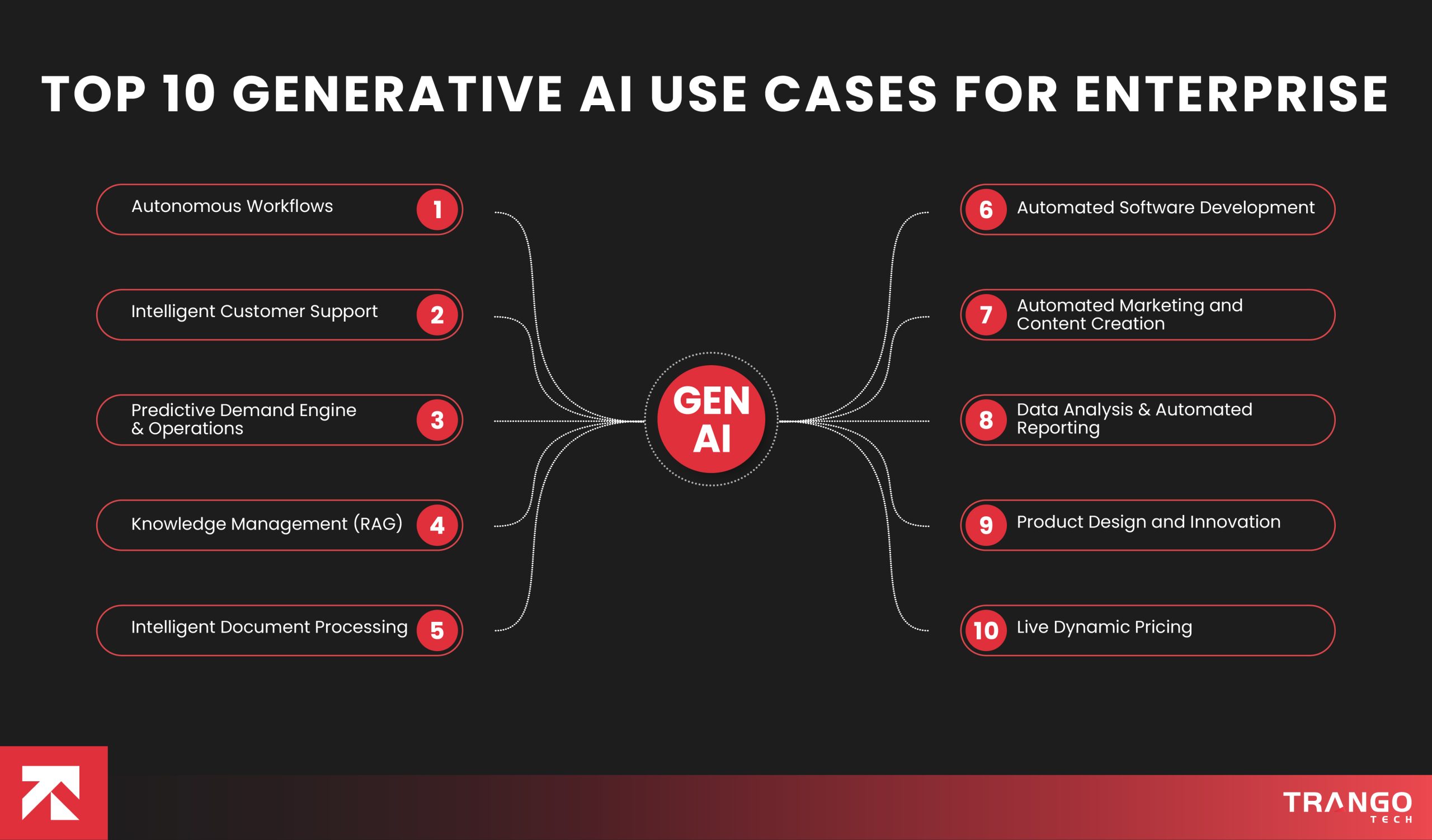
This guide introduces you to the top 10 generative AI use cases for enterprise and explains how industries are moving content to GenAI, with the cost justification and the compliance requirement.

Generative AI Use Cases for Enterprise: Key Challenges and Solutions

1. Autonomous Workflows

One of the best generative AI use cases for enterprise is automated workflows. By implementing this strategy, industries saved 80-90% of human working hours. The agent understands the goals, plans workflows, uses relevant tools, and gets the job done without human interference.

Recommended AI Use Cases for Business:

  1. AI Agent Development
  2. Generative AI Integration Services
  3. LLM Fine-Tuning & Optimization

Enterprise AI Use Cases:

  • Finance and banking
  • Healthcare
  • Retail & eCommerce
  • Supply Chain
  • Customer support
  • Legal services

2. Intelligent Customer Support

As per a study, about 80% of employees have improved their workflows with intelligent customer support. This generative AI for enterprises turns simple chatbots into smart assistants that understand tasks and then respond swiftly. It eases work for humans and summarizes the content for faster support.

Recommended AI Use Cases for Business:

  1. AI Chatbot & Copilot Development
  2. RAG Pipeline Development
  3. LLM Fine-Tuning & Optimization

Enterprise AI Use Cases:

  • Healthcare & telemedicine
  • Retail and eCommerce
  • Manufacturing

3. Predictive Demand Engine & Operations

Predictive analytics services use past records and external data to forecast customer behavior and offer discounts and promotions to those customers. Also identifies which products are customers most likely to buy, handles automated handling, and optimize logistics workflows. Companies were able to save up to 1.1 trillion loss annually by applying predictive generative AI use cases for enterprise.

Recommended Generative AI Software:

  1. Custom LLM Development
  2. Predictive data analysis
  3. Generative AI Integration Services

Enterprise AI Use Cases:

  • Retail & eCommerce
  • Manufacturing
  • Healthcare
  • Utilities
  • Transportation
  • Food and beverages

4. Knowledge Management (RAG)

As of recent facts, 80% of firms are using knowledge management for internal document queries and answers. This enterprise artificial intelligence works like an open book test method, in which the model doesn’t merely rely on general training for query answering; rather, it also searches into the company’s private data to give accurate answers rather than hallucinated answers.

Recommended Generative AI Software:

  1. RAG Pipeline Development
  2. AI Consulting & GenAI Strategy
  3. Generative AI Integration Services

Enterprise AI Use Cases:

  • Healthcare
  • Finance and banking
  • Legal
  • Customer support & IT

5 .Intelligent Document Processing (IDP)

Another abundantly used use case of generative AI applications is intelligent document processing (IDP). Around 70-80% of corporate info is stuck in unstructured PDFs, emails, and other documents. The IDP helps understand the scattered data, extract important info, and put data together in a human read friendly format for better content creation and understanding.

Recommended Generative AI Software:

  1. Generative AI Integration Services
  2. LLM Fine-Tuning & Optimization
  3. RAG Pipeline Development

Enterprise AI Use Cases:

  • Banking and financial services
  • Healthcare
  • Human resource
  • Manufacturing
  • Logistics
  • Insurance

6. Automated Software Development

Software development companies using automated software development generative AI use cases for enterprise build software 88% faster and much cheaper than companies relying merely on manual work. These solutions work as digital assistants and help engineers and developers to develop the application faster by writing the codes, testing the pilot, and automatically improving the workflows as per operational needs.

Recommended Generative AI Software:

  1. Multimodel AI Development
  2. AI Chatbot & Copilot Development
  3. Custom LLM Development

Enterprise AI Use Cases:

  • Supplychain
  • Manufacturing
  • Finance and banking
  • Healthcare & lifescience
  • Retail

7. Automated Marketing and Content Creation

A remarkable increase in marketers is noticed from 30% in 2024 to between 87% and 94% in 2026 for enterprise generative AI marketing and content creation. It uses artificial intelligence for marketing automation and content production. It works as a non-tiring digital assistant that creates content for social media, writes ad copy, product descriptions, and ideas for new campaigns launch.

Recommended Generative AI Software:

  1. LLM Fine-Tuning & Optimization
  2. Multimodel AI Development
  3. Generative AI Integration Services

Enterprise AI Use Cases:

  • eCommerce
  • Real Estate
  • FinTech
  • Healthcare
  • EdTech

8. Autonomous Predictive Maintenance

Manufacturing firms reported to save 50% to 90% in machine downtime by proactive predictive maintenance generative AI software. It forecast the upcoming model failures and fix the issues before they occur in reality.

Enterprise AI Use Cases:

  1. AI Agent Development
  2. Predictive analytics
  3. Multimodel AI Development

Enterprise AI Use Cases:

  • Manufacturing
  • Utilities
  • Transportations
  • Logistics

9. Product Design and Innovation

With the implementation of enterprise generative AI tools, the product development life cycle time is reduced by up to 70% so that developers can focus more on customer testing and optimize manufacturing. It works as a smart design assistant that thinks, develops, and tests new ideas.

Enterprise AI Use Cases:

  1. Custom LLM Development
  2. Multimodel AI Development
  3. AI Consulting & GenAI Strategy

Enterprise AI Use Cases:

  • Consumer electronics (wearable)
  • Automative
  • Healthcare
  • Retail
  • Manufacturing

10. Live Dynamic Pricing

Data analysis generative AI for enterprises goes through and assesses 500+ live unit prices. It works like a tireless pricing manager who never sleeps and keeps a vigilant eye on the market and set deal product costing. The solution helped achieve 16% increased revenue and profitability by 10%.

Enterprise AI Use Cases:

  1. Custom LLM Development
  2. Data analysis
  3. AI Agent Development

Enterprise AI Use Cases:

  • Hospitality
  • Transportation 
  • eCommerce
  • F&B

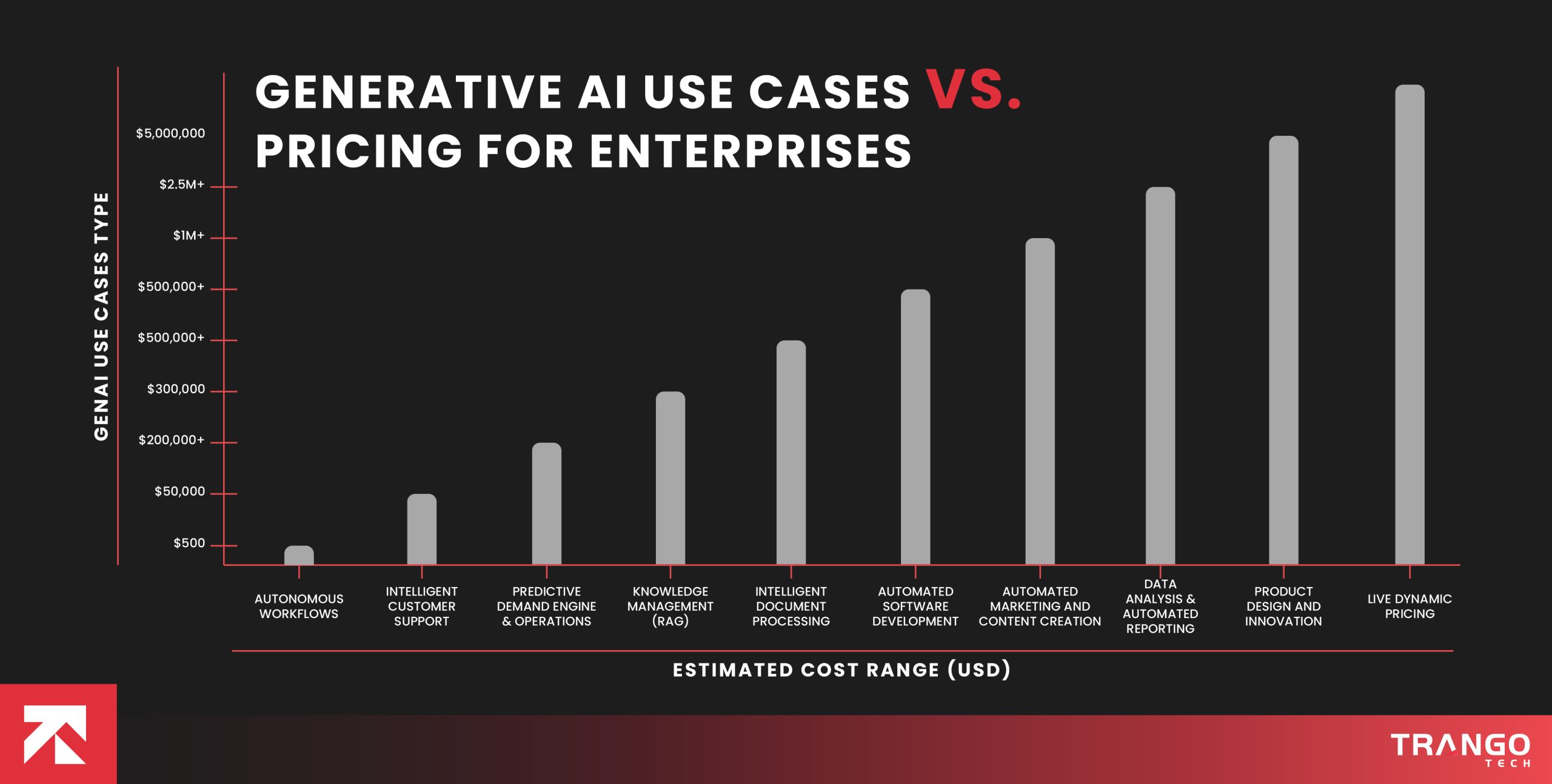
Generative AI Use Cases for Enterprise Scope VS. Pricing

Generative AI Use Cases for Enterprise Scope VS. Pricing

S. No. GenAI Use Cases Type Generative AI Applications Estimated Cost Range (USD) Best For
1 Autonomous Workflows Customer support, lead generation, supply chain and operations $10-$1M+ Large enterprises, SMEs, and startups
2 Intelligent Customer Support Advanced online assistance, Multilingual translation, and knowledge based maintenance   $15,000-$50,000 Enterprises and startups
3 Predictive Demand Engine & Operations Live demand prediction, proactive inventory management, and strategy planning $40,000-$500,000+ Enterprises
4 Knowledge Management (RAG) Intelligent search, data summary, and particular decision support $5,000-$300,000 Enterprises
5 Intelligent Document Processing Medical records, purchase order, and contracts $10,000-$200,000+ Enterprises and rapidly growing SMEs
6 Automated Software Development Bugs detection, test automation, and code generation $400-$500,000+ Startups and SMEs
7 Automated Marketing and Content Creation Copywriting, ideation, content generation and optimization $15-$500,0000+ Startups, Small and medium sized businesses
8 Data Analysis & Automated Reporting Automated storytelling, live dashboard build, and data cleaning $9-$500 SMEs and Startups
9 Product Design and Innovation AI designs generation, fast prototyping, and generative media $20,000-$500,0000 Startups and SMEs
10 Live Dynamic Pricing Monitors pricing, adjust rates, and generates personalized offer $40,000-$2.5M+ Enterprises

How Leading Industries are Transforming with Generative AI Applications

Leading-Industries-Transforming-with-GenAI-Applications-scaled

Generative AI automation is bringing evolutionary upgrades to businesses worldwide; around 71% of enterprises are using GenAI applications. Simply by automating tasks, firms have boosted their growth and saved labor hours.

Have a look at a few business applications for generative AI examples, and conversion rates sectors achieved by implementing these technologies.

Sector Specific Use Case Main GenAI Use Case Impact on Business Strategic Benefit
FinTech RAG and finance data analysis 34.8% quick data analysis and 78.6% correct data Live authentic insights
Healthcare Automated clinical documentation 70% reduced documentation durations and 320% ROI  Saved physicians time and helped them focused on core duty of saving lives
Retail and eCommerce Live dynamic pricing and virtual fitting Profit optimized up to 10%, sales up to 5%, and virtual fitting conversion up to 34% High conversion rates and improved customer life cycle value 
Manufacturing Predictive demand engine and operation, and predictive  Reduced machine downtime up to 50% Fasten products launch time and lower maintenance hustles
Legal Intelligent document processing Reduced data processing time up to 70%, reduces 40% errors, and attained 99% data accuracy  It fastened the time taking paperwork process
Logistics & Transportation Demand forecasting and predictive operations 25% lessen inventory cost and overstocking by 30% Allowed implementing right strategies at the right moment
Real Estate Intelligent document processing 75% cutback in labor cost and saved $1,500 per transaction It saves time and reduced manual typing mistakes in paperwork
HR Knowledge management (RAG) 70% quick info recovery and 60% reduced errors Reads HR policies and guide employees accordingly 
Agriculture Predictive demand engine and operations 23% enhanced crop production and reached USD 8.63B  Zero waste and maximum efficiency

Generative AI Use Cases for Enterprise: Key Challenges and Solutions

Top 10 Generative AI Use Cases for Enterprise: A Strategic Guide for US Entrepreneurs

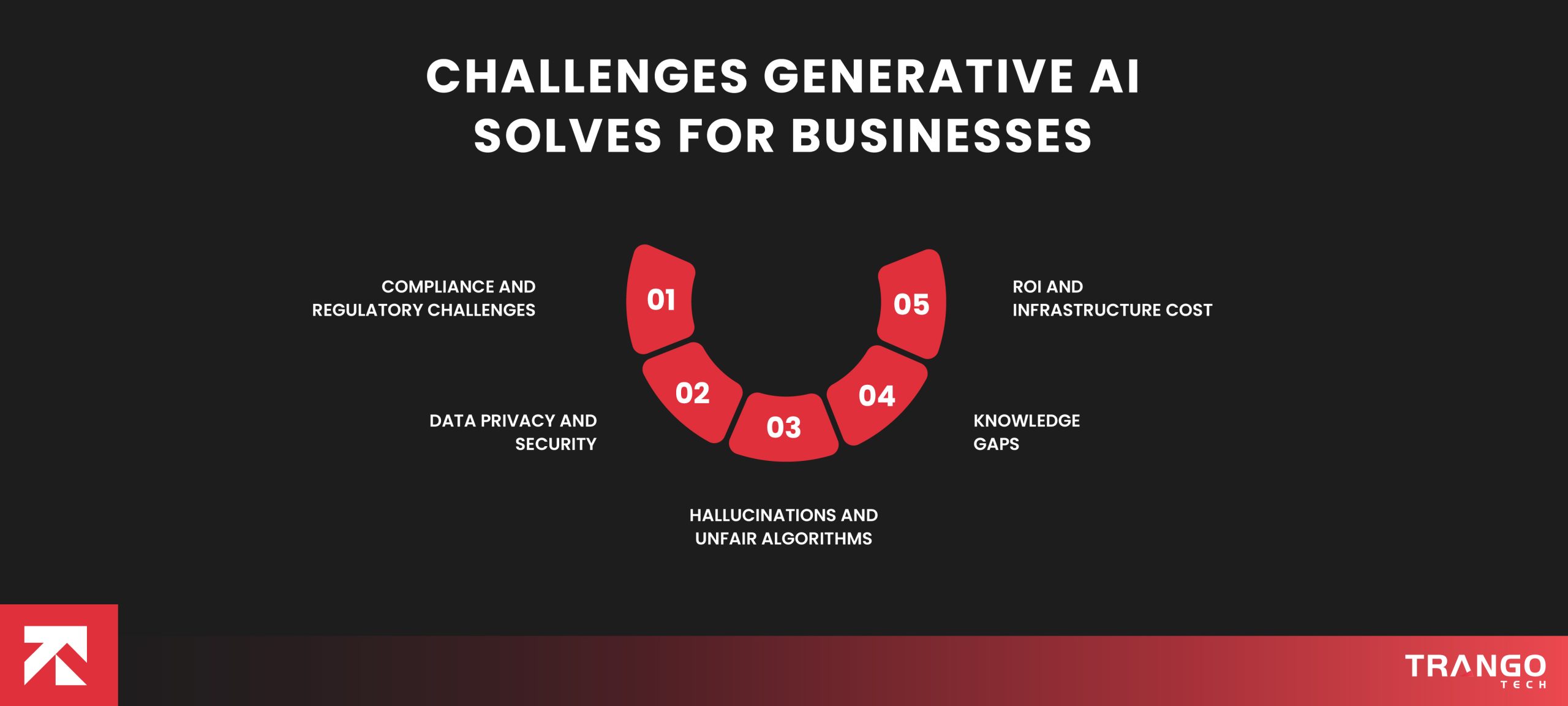
Generative AI capabilities are beyond the explanations, but there are some challenges that GenAI development encounters, like data privacy, model hallucinations, and programming complexity, etc. Explore the solution for each challenge below.

1. Compliance and Regulatory Challenges

The Challenge:

Enterprises choosing generative AI services will encounter audit trails, confidentiality concerns, live flagging systems, and compliance clause adherence.

The Solutions:

Recruit expert staff, make compliance a part of your model infrastructure, or hire Trango Tech, known for proactively committing to regulatory compliance in the US.

2. Data Privacy and Security

The Challenge:

The use of LLMs for company proprietary data may result in data safety issues or leakage.

The Solutions:

Execute internal deployments and always prefer authentic platforms like Trango’s Generative AI development services.

3. Hallucinations and Unfair Algorithms

The Challenge:

GenAI can make mistakes, give inaccurate results, and provide false information in case of bulk data or out of the context queries.

The Solutions:

Use the RAG technique or choose a software development company in the USA whose deployments are barriered with a 7-axis eval gatepass like Trango Tech.

4.Knowledge Gaps

The Challenge:

Deploying generative AI technology requires robust domain knowledge. You cannot ship a model without proper data cleaning strategies and architectures. 

The Solutions:

Implementation of RAG or AI agents gives your firm a private space for testing and a digital agent for verified responses.

5.ROI and Infrastructure Cost

The Challenge:

The firms may face expenses of high architectural rates, PoCs, efficient infrastructure, and no real profit and loss statements. 

The Solutions:

Enterprises should use less complex AI systems like automated customer support and knowledge management (RAG).

Why Trango Tech is the Best Choice for Enterprise Generative AI Use Cases

As of recent facts, 95% of firms are deploying GenAI models to production because of process flow integration failures. Trango Tech is a generative AI platform that has successfully deployed 500+ AI and software solutions globally, with a 19 out of 20 success score rate.

As for generative AI use cases for enterprise, we focus on quick proof of concepts, integration based on strong application needs, maintain records and case studies of production released projects.

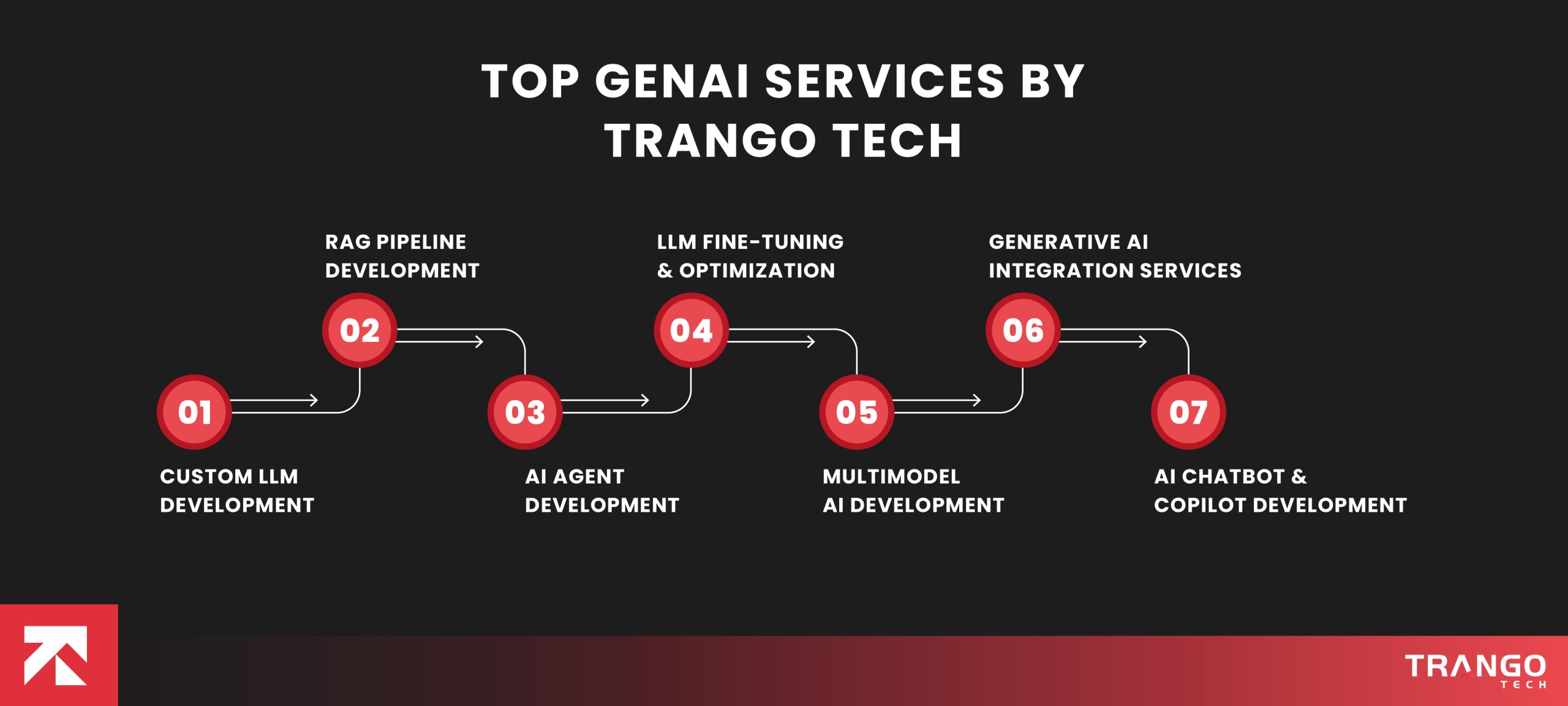
Top GenAI Services Offered By Trango Tech

Top-GenAI-Services-By-Trango-Tech-

  1. Custom LLM Development
  2. RAG Pipeline Development
  3. AI Agent Development
  4. LLM Fine-Tuning & Optimization
  5. Multimodel AI Development
  6. Generative AI Integration Services
  7. AI Chatbot & Copilot Development
  8. AI Consulting & GenAI Strategy

Final Thoughts

In order to turn your daily profit into boosted ROI, you should get confused and choose whatever AI tech option is in front of you. Rather, choose a firm that guides you to choose the right model and generative AI use cases for enterprise to build the most suitable agent as per your business needs for converted numbers.

At Trango Tech, we offer generative AI consulting services for you to come up with better decisions of either build or buy the solution. Our mission is not only to deploy a model but to bring multiple agents that handle complex tasks smoothly and boost your ROI.

What is Generative AI? A Complete Guide for Business Leaders

Businesses all across the globe are turning to AI and implementing it in their day-to-day tasks. Look around you; someone in your company is probably already using ChatGPT to draft emails or generate ideas. Nobody trained them; they’re just using it because it speeds up their work.

That’s generative AI in its simplest form: a technology that creates text, images, code, and even videos instead of just sorting or analyzing data, as older AI did. You give it instructions, and it comes up with something new. No coding needed, no tech team required to try it out.

The numbers back this up too. Close to 8 out of 10 businesses are already using generative AI in some part of their operations, writing content, answering customers, generating code, and doing in minutes what used to take teams hours.

But knowing it exists isn’t the same as knowing how to use it well. That’s exactly what this guide is for. We’ll break down what generative AI actually is, how it works, where it fits in your business, and where the right technical partner can help you build it properly.

Let’s define generative AI first!

What is Generative AI?

Generative AI, also known as Gen AI, is an artificial intelligence system designed to create content such as text, images, audio, video, and software code in response to users’ prompts and requests.

These generative AI models create original content distinct from human-generated content. They use techniques such as deep learning and neural networks to generate output.

How Does Generative AI Work?

How Does Generative AI Work?

Generative AI uses machine learning models pre-trained on vast amounts of data. Here’s how

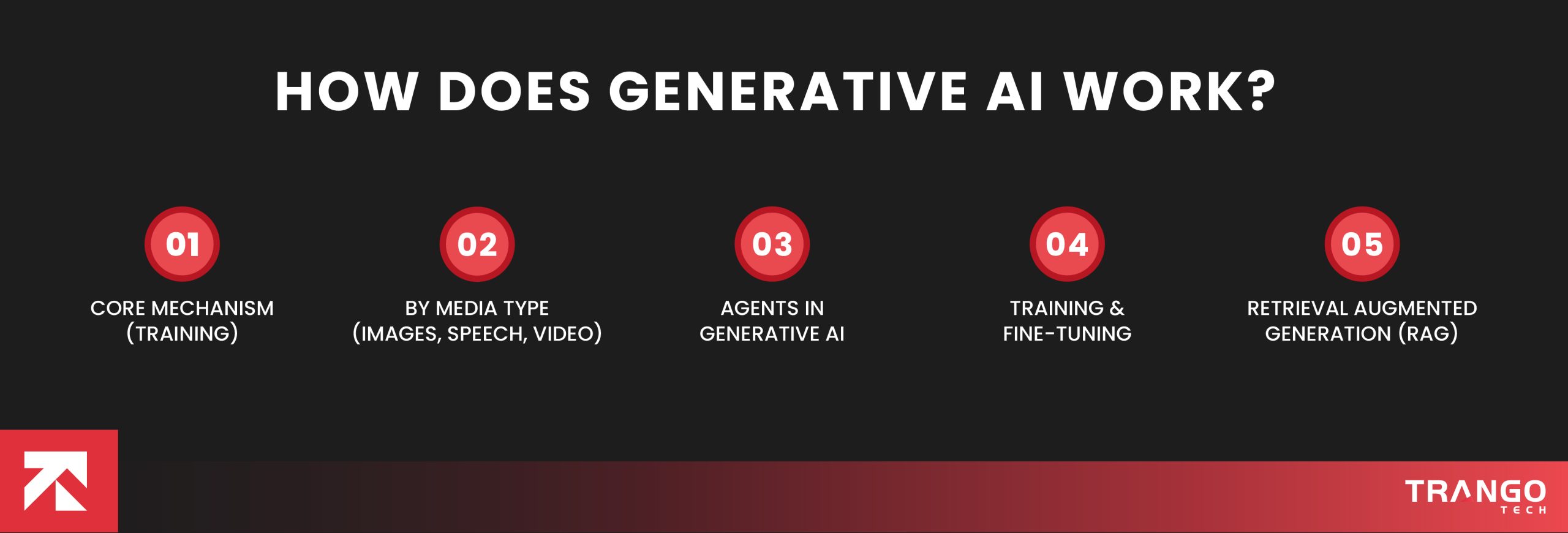
1. Core Mechanism (Training)

Generative AI is trained on large datasets like text, images, audio, or video using deep learning networks. During training, the model learns millions or even billions of parameters that help it predict or generate content. After training, it can generate output based on learned patterns or prompts.

2. By Media Type

For text-based answers, generative AI models use large language models (LLMs) to predict the next token, enabling them to generate logical paragraphs or essays.

Images: Diffusion models such as DALL-E, Midjourney, and Imagen create new data by adding random noise to training samples and then learning to reverse the process step by step, turning static noise into coherent, realistic content.

Speech: Text-to-speech models create human-like voices by deriving acoustic features from a prompt.

Video: Multimodal systems such as OpenAI’s Sora and Runway create short, temporally coherent video clips from text or other prompts.

3. Agents in Generative AI:

In generative AI, an agent is an autonomous component powered by a large language model (LLM) that perceives the environment, processes it, and generates a response accordingly. Unlike standard chatbots, which generate only text-based responses, they can complete multi-step tasks independently.

4. Training & Fine-tuning:

LLMs are trained on large general corpora using self-supervised methods. After extensive training, they become pre-trained and can be further trained on domain-specific labeled data to adapt to specialized tasks or stylistic needs. This process is called fine-tuning, and it can be performed using.

  • LoRA
  • QLoRA
  • Peft
  • Reinforcement learning from human feedback (RLHF)
  • LLM Distillation

5. Retrieval Augmented Generation (RAG):

It is an AI technique used by modern systems that modifies LLM responses by fetching facts from external knowledge bases before generating an answer.

It retrieves relevant documents to produce accurate, up-to-date information, reduce hallucinations, and improve output precision.

Types of Generative AI Models

Types of Generative AI Models

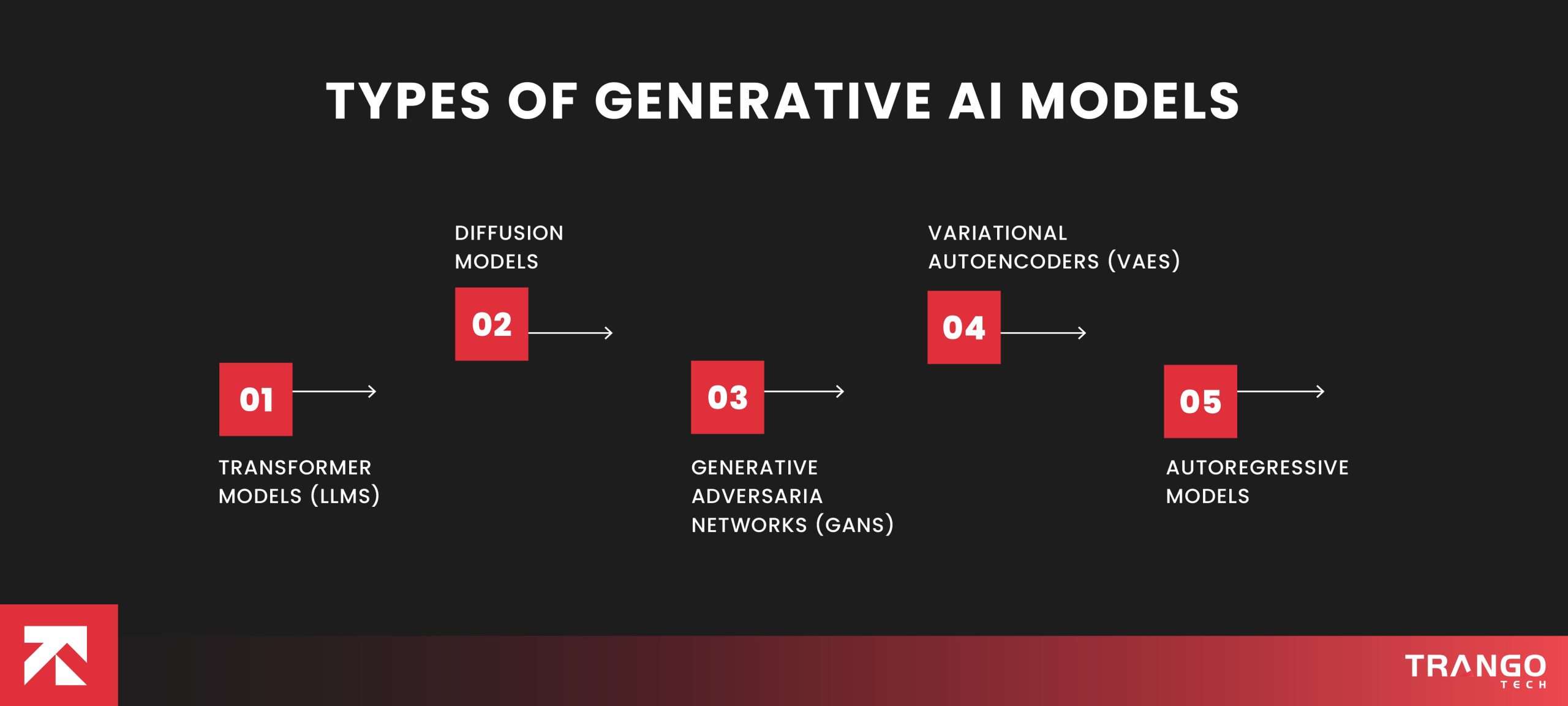
1. Transformer Models (LLMs)

Transformer models are specialized in processing and generating natural language and code. Autoregressive transformer models generate responses by predicting the next token in a sequence based on previous tokens, moving step by step through the text.

(In AI, a token is the basic unit of data that a model reads and generates. Instead of reading whole words, AI breaks down the text into short fragments such as parts of words, single characters, or punctuation.)

Examples: Popular transformer models include GPT models, which can generate logically context-aware paragraphs, solve coding tasks, and answer complex queries.

2. Diffusion Models:

A diffusion model is currently the gold standard for highly accurate image and video generation. It works by incrementally scattering random pixels across an image and then training the model to reverse the process, thereby reconstructing a highly realistic output.

Examples: Midjourney, Stable Diffusion, and OpenAI’s DALL-E

3. Generative Adversarial Networks (GAN)

They consist of two neural networks: a generator and a discriminator. They compete with one another. The generator produces an output, and the discriminator evaluates it for realism.

This competitive feedback loop, in turn, generates incredibly sharp images, synthetic data, and deepfakes.

4. Variational Autoencoders (VAEs):

These Gen AI models compress input data into a simplified latent-space representation and then reconstruct it to generate new variations.

They are the perfect choice for anomaly detection, molecular design in drug discovery, and scientific simulations.

5. Autoregressive Models:

Autoregressive (AR) models are a class of time-series models used for forecasting. They model the relationship between an observation and several lagged observations.

They generate data sequentially, predicting the next element based on previous ones. They are the mathematical backbone of many sequence-based generation tools, including music and raw text generation.

Business Applications of Generative AI

Business Applications of Generative AI

Organizations often invest in generative AI without even realizing which capabilities will impact their business.

Here are the seven most common use cases for generative AI that deliver consistent value across industries, with practical guidance on where each application has the strongest impact.

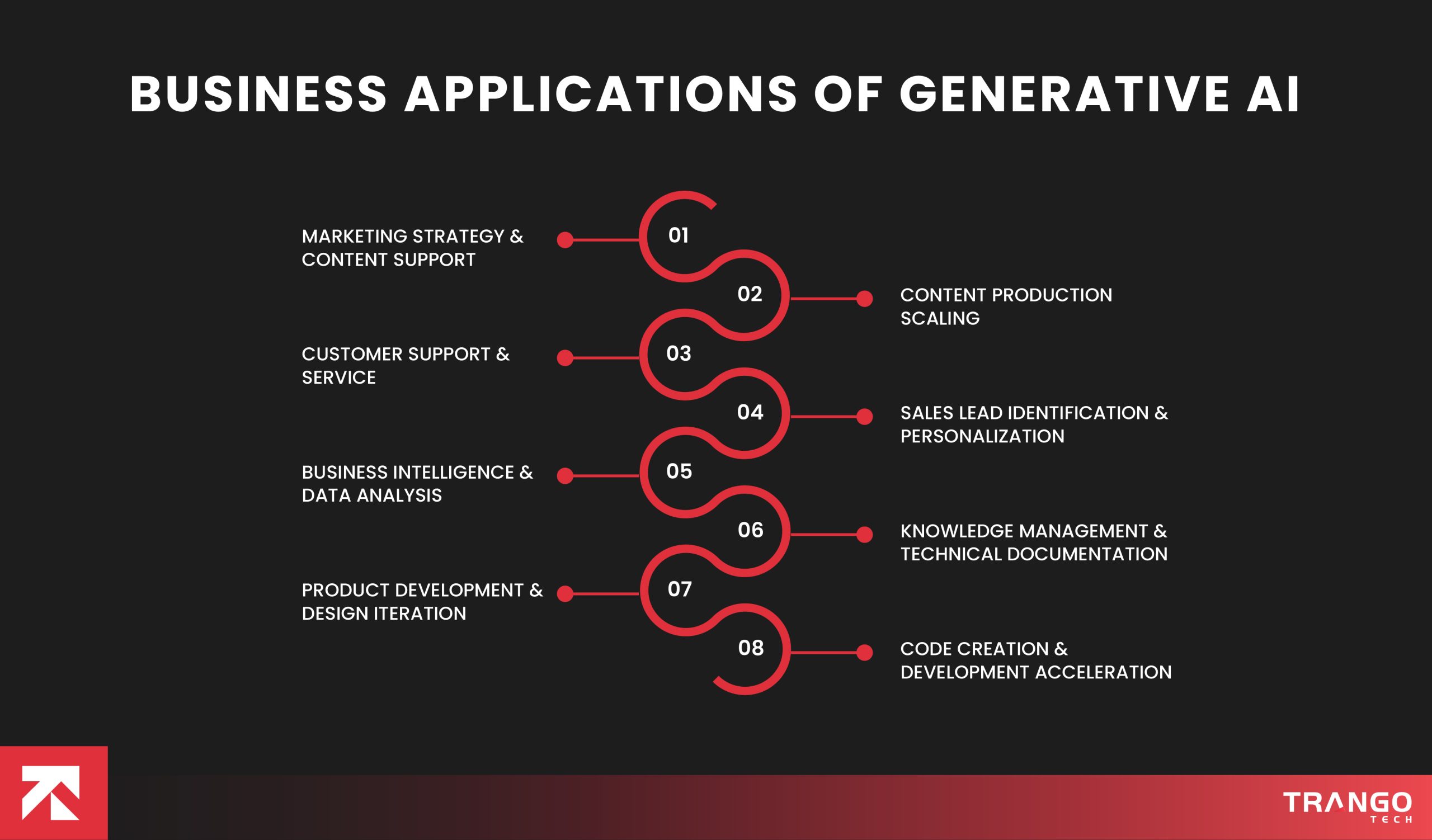
1. Marketing Strategy & Content Support:

Marketing teams are under constant pressure to produce content across all channels without increasing the budget. Gen AI helps by generating large amounts of content in less time while maintaining creativity.

Organizations implementing the AI content strategy observe increased content creation and improved campaign planning effectiveness.

Using generative AI software, marketing teams can draft campaign briefs, develop content strategies, generate variations of advertising copy, and quickly create technical marketing content.

Key Application Areas:

AI helps create marketing strategy documents, campaign briefs, and competitive analyses by gathering and consolidating marketing data.

2. Content Production Scaling:

It helps the team generate content variations for different audiences, channels, and campaign objectives, enabling personalized messaging without increasing creative resources.

Marketing leaders can use generative AI to discover and generate creative concepts, develop messaging frameworks, and craft campaign themes.

3. Customer Support & Service:

An initial conversation isn’t enough in sales. Customer support and service are important parts of it, as they show how concerned you are about your clients.

In this area, generative AI is truly exceptional, improving operational efficiency, enhancing customer satisfaction, and reducing agent turnover.

4. Sales Lead Identification & Personalization:

The marketing team generates demand, but the sales team converts that demand into revenue. AI helps build a sales pipeline by prioritizing data-driven leads and tailoring outreach.

Sales organizations using generative AI achieve higher conversion rates. It must be integrated into existing CRM workflows.

5. Business Intelligence & Data Analysis:

AI-powered data analysis improves decision-making by turning raw data into strategic intelligence.

Businesses implementing AI-powered data analysis observed faster decision-making and improved analytical capabilities, rather than a replacement of human judgment.​

6. Knowledge Management & Technical documentation:

The insights gathered from business intelligence are only valuable if the team can access & implement them.

Using an AI-powered knowledge management system significantly improves information accessibility, documentation quality, and the preservation of institutional knowledge.

7. Product Development & Design Iteration:

Production teams implement generative AI capabilities into design and development workflows, achieve notable efficiency gains, and maintain creative control.

Teams with strong AI capabilities generate images and text directly into the existing design workflows.

8. Code Creation & Development Acceleration:

Integrate AI into coding workflows through natural language-to-code translation, automated debugging assistance, and intelligent test development.

Success requires more than tool deployment; the team needs guidance on prompt engineering and code review practices, as well as integration workflows that support AI capabilities while preserving maintainability standards.

Benefits of Generative AI for Businesses:

Benefits of Generative AI for Businesses:

The most obvious and common benefit of generative AI solutions is greater efficiency. Generative AI is set to automate and revolutionize tasks with its enhanced capabilities.

Automating labor-intensive tasks reduces costs and frees up time for employees to invest in more valuable work.

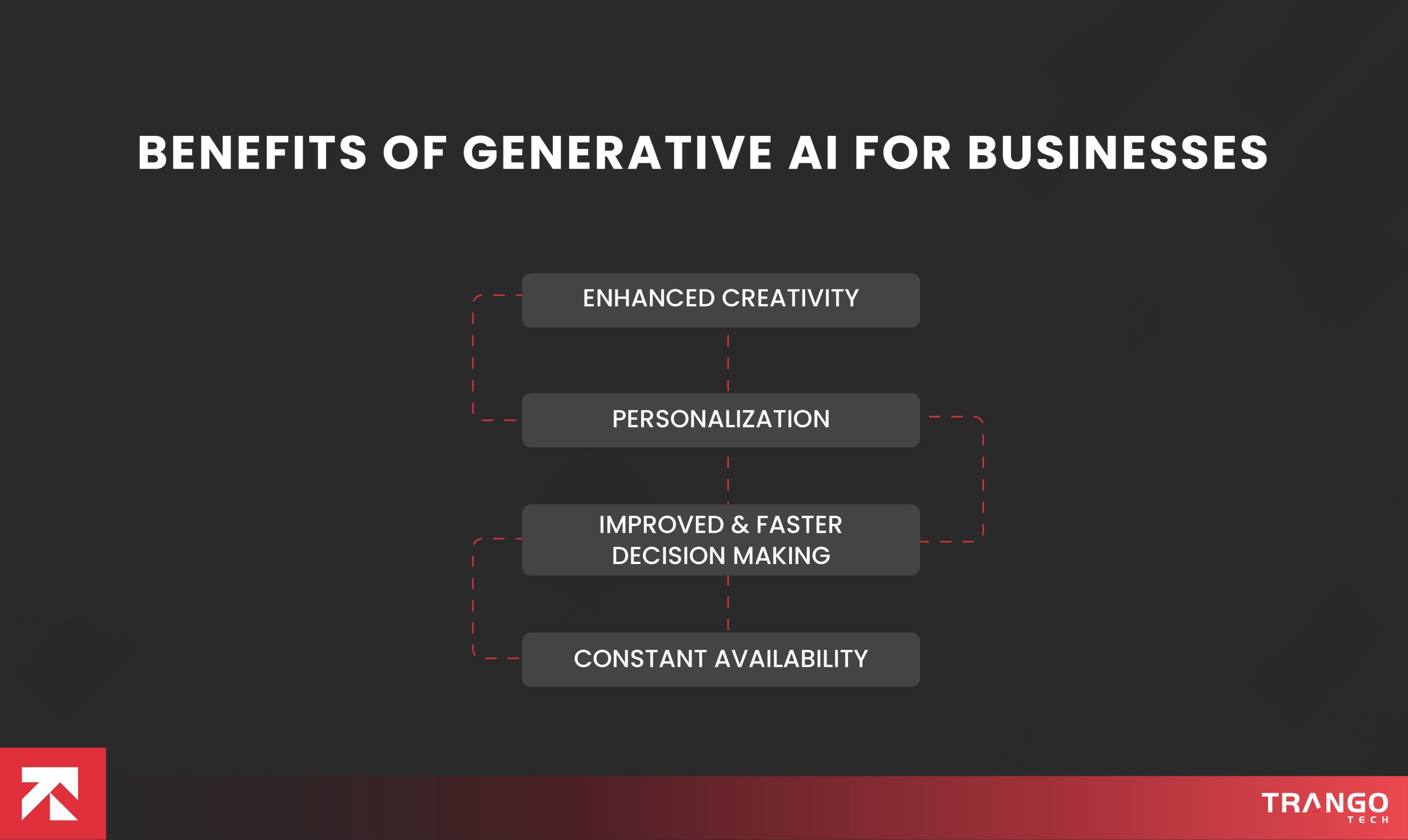
1. Enhanced Creativity:

Gen AI capabilities can improve the efficiency and creativity of any task. It offers automated brainstorming, generating multiple novel versions of content.

These variations in responses help writers, artists, designers, and other creators generate creative ideas.

2. Improved & faster Decision Making:

Generative AI solutions excel at analyzing large datasets, identifying patterns, and extracting meaningful insights. It then interprets the insights, generating hypotheses and recommendations to support executives, analysts, researchers, and other professionals in making data-driven, informed decisions.

3. Personalization:

Utilizing generative AI in applications where recommendations are a crucial part of the application. Generative AI analyzes user behavior, preferences, and history to generate personalized content in real time, resulting in a customized and engaging user experience.

4. Constant Availability:

The best thing about generative AI is that it is available round-the-clock and can work 24/7 without getting tired. It is the best solution for offering customer support chatbots and automated responses.

Challenges, Limitations, and Risks Related to Generative AI

Challenges, Limitations, and Risks Related to Generative AI

Generative AI has come a long way in a short period of time. Not to ignore the fact that it still has various challenges and risks for developers and users.

Below are the most common issues and how they’re being addressed.

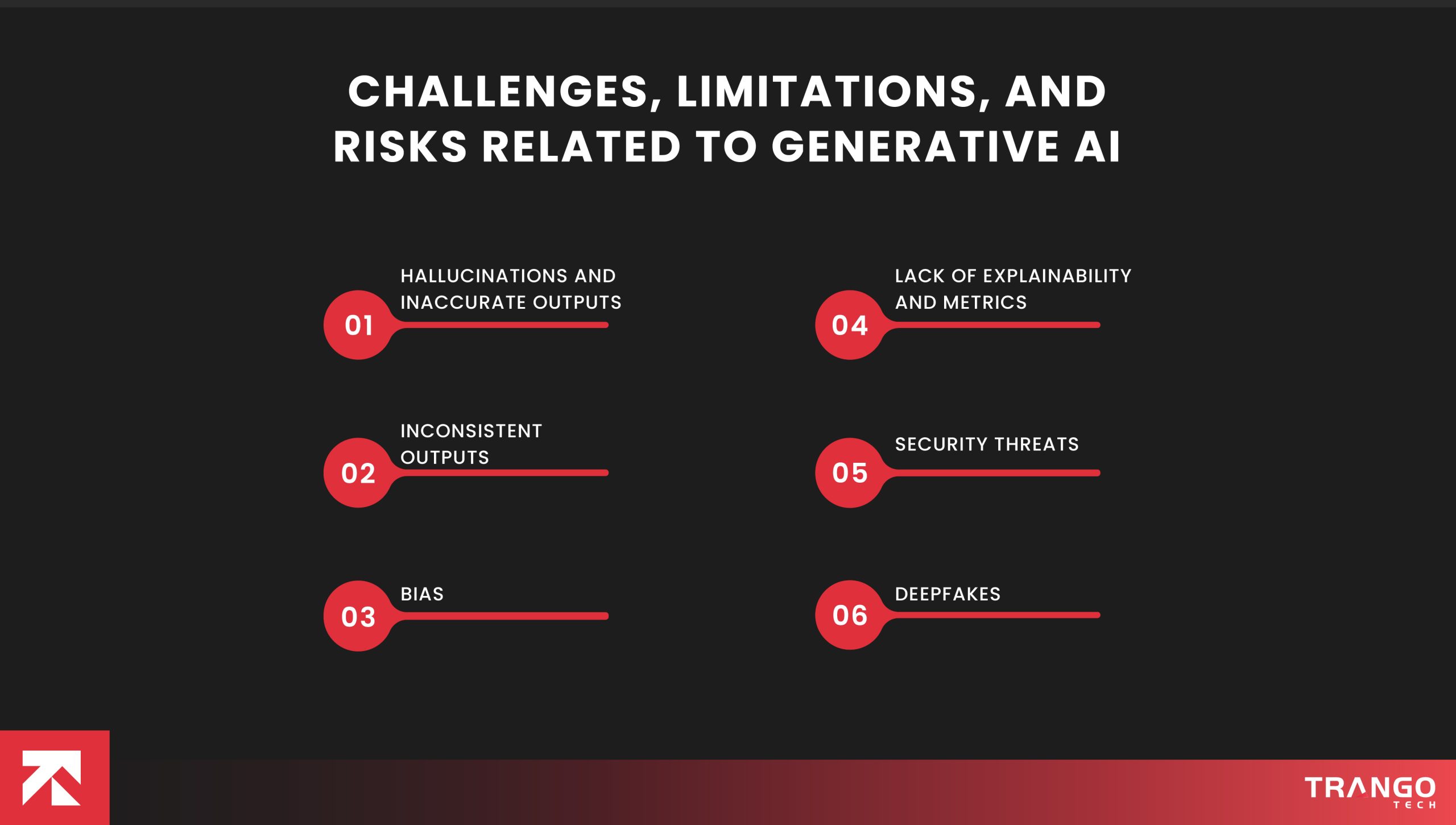
1. Hallucinations and Inaccurate Outputs:

AI often hallucinates; yes, that may sound weird, but it is a fact. It means it produces illogical, nonsensical output. It often creates fictional use cases with quotes and numbers.

Some practitioners have concluded that this is an unavoidable trade-off between accuracy & maintaining creativity.

But to avoid these hallucinations, there’s a preventive measure called guardrails that restrict the model to relevant or trusted data sources.

2. Inconsistent Outputs:

Generative AI is probabilistic; thus, it produces variations in its output even with the same input. But this becomes highly problematic and unacceptable, especially in applications such as customer support chatbots, where consistent output is desirable.  

3. Bias:

Training data can be societally biased, leading to bias in generative AI. Even if it learns societal biases from labeled data, external data sources, and human evaluators, it can still generate biased, unfair, and offensive content.

Developers must ensure they provide diverse training data to their generative AI model to prevent biased outputs. They must also create guidelines to prevent bias during training and tuning. They must also regularly evaluate the model’s outputs for bias to assess accuracy.

4. Lack of Explainability And Metrics:

Some generative AI models operate in a ‘BLACK BOX,’ meaning you won’t understand what’s happening internally or how decisions are made.

So, there is a dire need for explainable AI practices and techniques to help practitioners and users understand the processes and outputs of generative models.

5. Security Threats:

Security concerns may arise if sensitive data is used to train generative AI models. There must be proper checks and balances to ensure that generative AI tools produce responses that limit unauthorized access to proprietary information.

Generative AI models can also produce phishing emails, fake identities, and other forms of malware, fooling users into taking actions that compromise security or data privacy.

Developers must be very cautious about the data they input into the model during training or as part of a prompt, so that it does not reveal their own intellectual property (IP) or any other information protected as IP by other organizations.

6. Deepfakes:

Deepfakes are AI-generated hyper-realities, manipulated images, videos, or audio. They mimic the person’s likeness by analyzing footage and voice samples of the real person.

This generative AI activity promotes fraud by allowing fraudsters or creators to make it appear as though they said or did things they never actually did.

It is the most dangerous thing about artificial intelligence to date, as it can damage a person’s reputation within seconds.

How to Adopt Generative AI in Your Business?

Adopting generative AI in businesses requires a structured approach that balances speed-to-value with operational discipline.

When organizations move from pilot to production without a clear strategy, they frequently encounter scaling issues and governance gaps that undermine business value and trust.

Mapping Processes Suitable for Generative AI Automation:

Those business processes that are highly document-intensive and generate large volumes of information.

These types of documentation involve contract reviews, report generation, compliance monitoring, etc.

Inventorying Proprietary Data Sources:

To train or ground AI on internal data, you must evaluate and prepare your information landscape.

Data Mapping: Locate where unstructured and structured data lives across your company. Eg, CRMS, ERPs, shared drives, and project management tools.

Quality and Cleaning: Consolidate the spreadsheets and fix formatting errors so the AI receives consistent information.

Security & Governance: Implement strict data governance frameworks to restrict access by employee role, mask personal information, and prevent the leakage of confidential IP.

Architecture Selection: Determine how you feed this data to the AI model.

The following options are included:

Prompt Engineering: Passing contextual data directly into the chat box.

RAG: Allowing AI to query. Connect your internal, proprietary datasets to a pretrained model dynamically, minimizing hallucinations and keeping data up to date.

Fine-tuning: Customize an existing foundational model specifically on your domain data.

Future of Generative AI in Business:

As we all know, generative AI is becoming more than just a productivity innovation; it’s a core operational engine. It is fundamentally altering core business processes, including decision-making, customer service, and business planning.

It’s not replacing humans; it’s just a myth. It’s just making humans’ tasks easier. It focuses on augmenting staff, requiring organizations to heavily invest in workforce training and AI-driven skill development.

How Trango Tech Can Help You Implement Gen AI?

Understanding generative ai meaning is one thing. Actually building it into your business without wasting months or budget on the wrong approach is another. That’s where Trango tech steps in.

We work with businesses to turn generative AI ideas into solutions that actually run within their operations. It includes custom AI solutions, seamless integrations, and customer support. So you don’t need to become an AI expert. You just need a team that already is one.​