What is Generative AI? A Complete Guide for Business Leaders
Businesses all across the globe are turning to AI and implementing it in their day-to-day tasks. Look around you; someone in your company is probably already using ChatGPT to draft emails or generate ideas. Nobody trained them; they’re just using it because it speeds up their work. That’s generative AI in its simplest form: a […]
Businesses all across the globe are turning to AI and implementing it in their day-to-day tasks. Look around you; someone in your company is probably already using ChatGPT to draft emails or generate ideas. Nobody trained them; they’re just using it because it speeds up their work.
That’s generative AI in its simplest form: a technology that creates text, images, code, and even videos instead of just sorting or analyzing data, as older AI did. You give it instructions, and it comes up with something new. No coding needed, no tech team required to try it out.
The numbers back this up too. Close to 8 out of 10 businesses are already using generative AI in some part of their operations, writing content, answering customers, generating code, and doing in minutes what used to take teams hours.
But knowing it exists isn’t the same as knowing how to use it well. That’s exactly what this guide is for. We’ll break down what generative AI actually is, how it works, where it fits in your business, and where the right technical partner can help you build it properly.
Let’s define generative AI first!
What is Generative AI?
Generative AI, also known as Gen AI, is an artificial intelligence system designed to create content such as text, images, audio, video, and software code in response to users’ prompts and requests.
These generative AI models create original content distinct from human-generated content. They use techniques such as deep learning and neural networks to generate output.
How Does Generative AI Work?
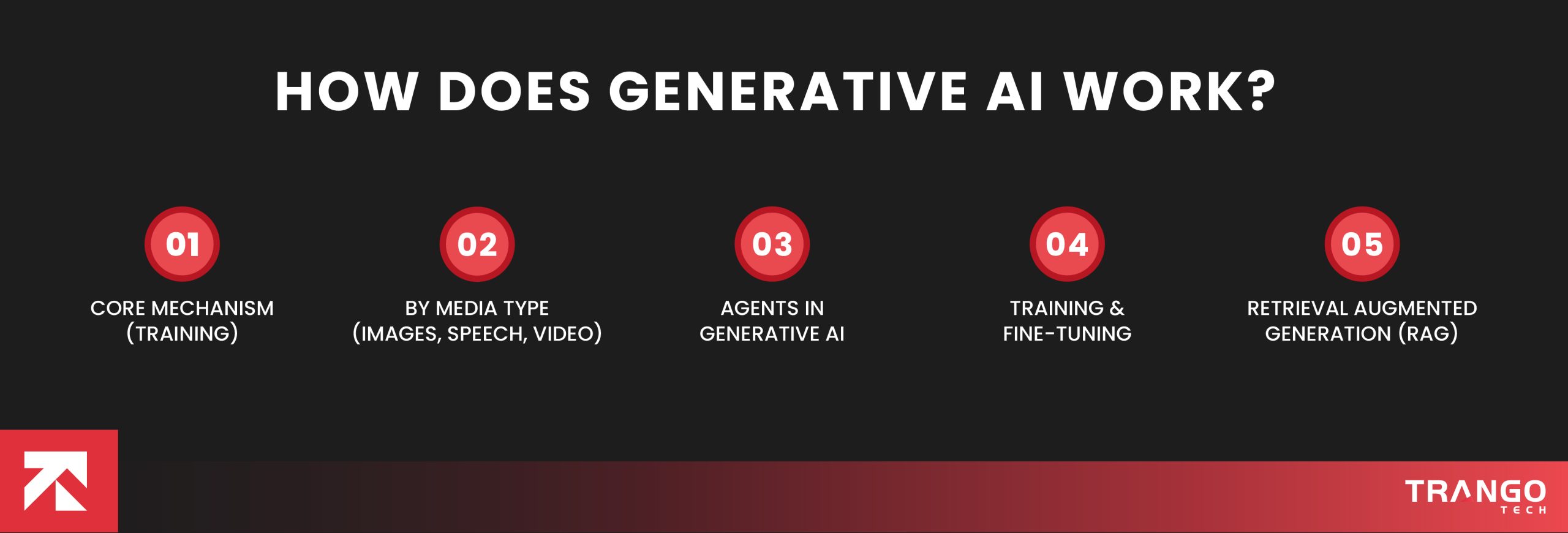
Generative AI uses machine learning models pre-trained on vast amounts of data. Here’s how
1. Core Mechanism (Training)
Generative AI is trained on large datasets like text, images, audio, or video using deep learning networks. During training, the model learns millions or even billions of parameters that help it predict or generate content. After training, it can generate output based on learned patterns or prompts.
2. By Media Type
For text-based answers, generative AI models use large language models (LLMs) to predict the next token, enabling them to generate logical paragraphs or essays.
Images: Diffusion models such as DALL-E, Midjourney, and Imagen create new data by adding random noise to training samples and then learning to reverse the process step by step, turning static noise into coherent, realistic content.
Speech: Text-to-speech models create human-like voices by deriving acoustic features from a prompt.
Video: Multimodal systems such as OpenAI’s Sora and Runway create short, temporally coherent video clips from text or other prompts.
3. Agents in Generative AI:
In generative AI, an agent is an autonomous component powered by a large language model (LLM) that perceives the environment, processes it, and generates a response accordingly. Unlike standard chatbots, which generate only text-based responses, they can complete multi-step tasks independently.
4. Training & Fine-tuning:
LLMs are trained on large general corpora using self-supervised methods. After extensive training, they become pre-trained and can be further trained on domain-specific labeled data to adapt to specialized tasks or stylistic needs. This process is called fine-tuning, and it can be performed using.
- LoRA
- QLoRA
- Peft
- Reinforcement learning from human feedback (RLHF)
- LLM Distillation
5. Retrieval Augmented Generation (RAG):
It is an AI technique used by modern systems that modifies LLM responses by fetching facts from external knowledge bases before generating an answer.
It retrieves relevant documents to produce accurate, up-to-date information, reduce hallucinations, and improve output precision.
Types of Generative AI Models
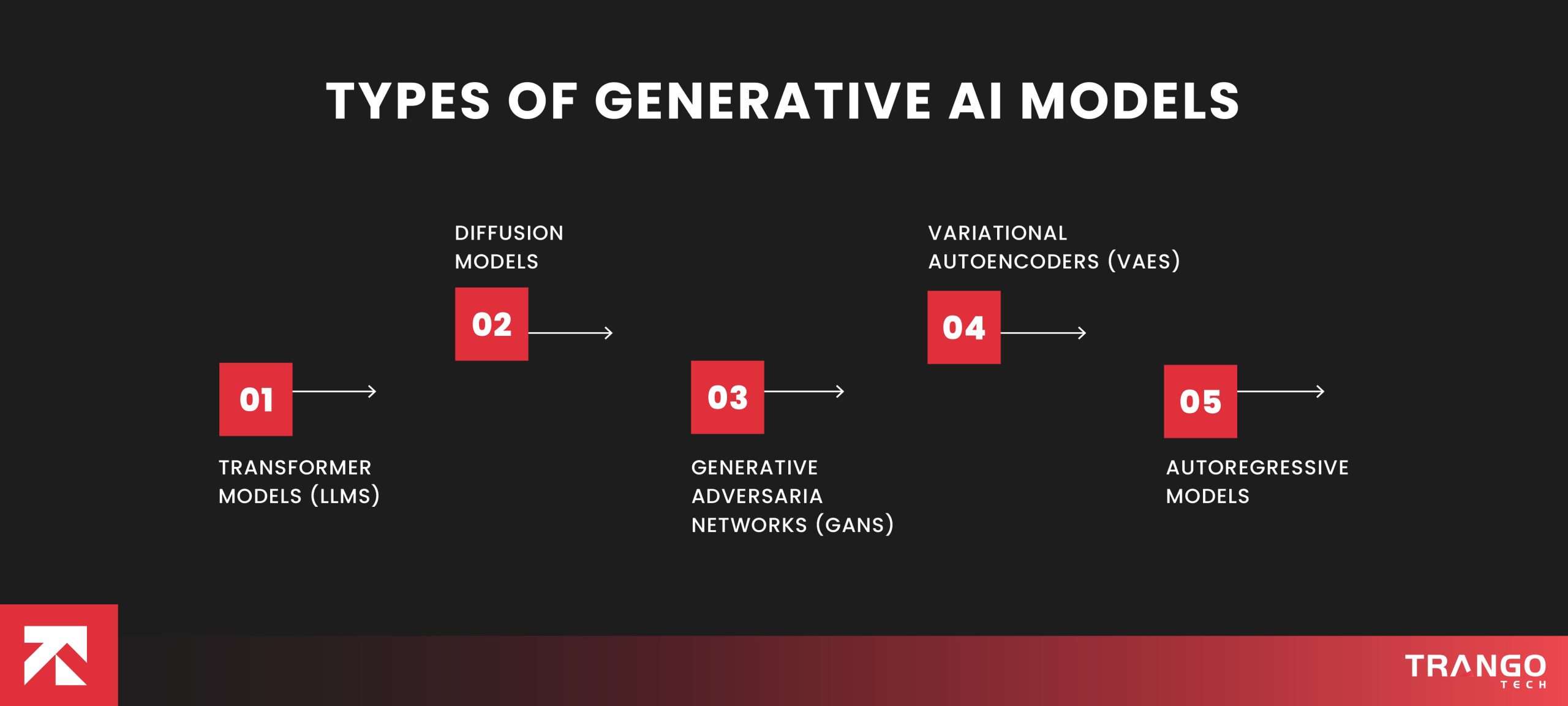
1. Transformer Models (LLMs)
Transformer models are specialized in processing and generating natural language and code. Autoregressive transformer models generate responses by predicting the next token in a sequence based on previous tokens, moving step by step through the text.
(In AI, a token is the basic unit of data that a model reads and generates. Instead of reading whole words, AI breaks down the text into short fragments such as parts of words, single characters, or punctuation.)
Examples: Popular transformer models include GPT models, which can generate logically context-aware paragraphs, solve coding tasks, and answer complex queries.
2. Diffusion Models:
A diffusion model is currently the gold standard for highly accurate image and video generation. It works by incrementally scattering random pixels across an image and then training the model to reverse the process, thereby reconstructing a highly realistic output.
Examples: Midjourney, Stable Diffusion, and OpenAI’s DALL-E
3. Generative Adversarial Networks (GAN)
They consist of two neural networks: a generator and a discriminator. They compete with one another. The generator produces an output, and the discriminator evaluates it for realism.
This competitive feedback loop, in turn, generates incredibly sharp images, synthetic data, and deepfakes.
4. Variational Autoencoders (VAEs):
These Gen AI models compress input data into a simplified latent-space representation and then reconstruct it to generate new variations.
They are the perfect choice for anomaly detection, molecular design in drug discovery, and scientific simulations.
5. Autoregressive Models:
Autoregressive (AR) models are a class of time-series models used for forecasting. They model the relationship between an observation and several lagged observations.
They generate data sequentially, predicting the next element based on previous ones. They are the mathematical backbone of many sequence-based generation tools, including music and raw text generation.
Business Applications of Generative AI
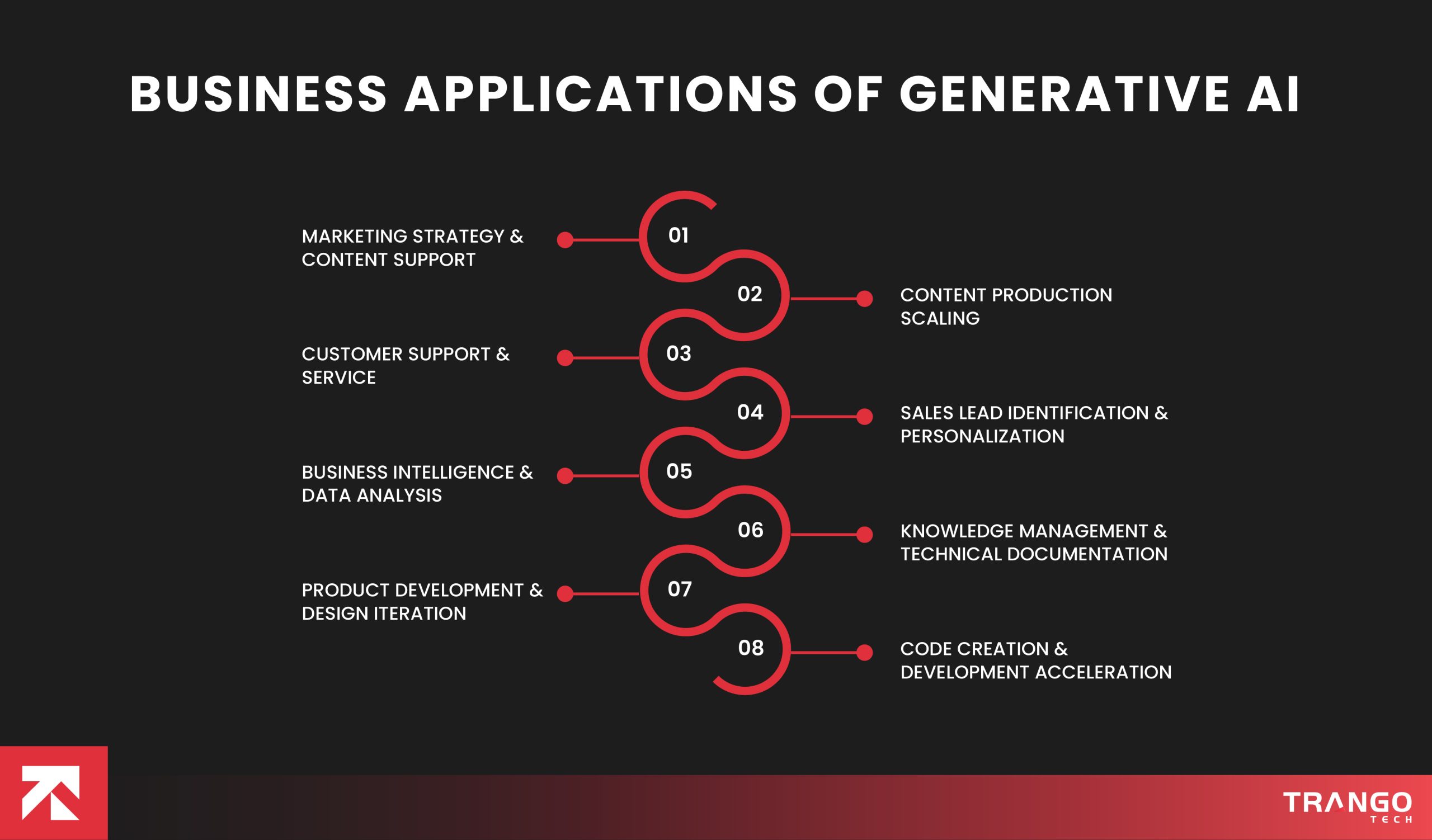
Organizations often invest in generative AI without even realizing which capabilities will impact their business.
Here are the seven most common use cases for generative AI that deliver consistent value across industries, with practical guidance on where each application has the strongest impact.
1. Marketing Strategy & Content Support:
Marketing teams are under constant pressure to produce content across all channels without increasing the budget. Gen AI helps by generating large amounts of content in less time while maintaining creativity.
Organizations implementing the AI content strategy observe increased content creation and improved campaign planning effectiveness.
Using generative AI software, marketing teams can draft campaign briefs, develop content strategies, generate variations of advertising copy, and quickly create technical marketing content.
Key Application Areas:
AI helps create marketing strategy documents, campaign briefs, and competitive analyses by gathering and consolidating marketing data.
2. Content Production Scaling:
It helps the team generate content variations for different audiences, channels, and campaign objectives, enabling personalized messaging without increasing creative resources.
Marketing leaders can use generative AI to discover and generate creative concepts, develop messaging frameworks, and craft campaign themes.
3. Customer Support & Service:
An initial conversation isn’t enough in sales. Customer support and service are important parts of it, as they show how concerned you are about your clients.
In this area, generative AI is truly exceptional, improving operational efficiency, enhancing customer satisfaction, and reducing agent turnover.
4. Sales Lead Identification & Personalization:
The marketing team generates demand, but the sales team converts that demand into revenue. AI helps build a sales pipeline by prioritizing data-driven leads and tailoring outreach.
Sales organizations using generative AI achieve higher conversion rates. It must be integrated into existing CRM workflows.
5. Business Intelligence & Data Analysis:
AI-powered data analysis improves decision-making by turning raw data into strategic intelligence.
Businesses implementing AI-powered data analysis observed faster decision-making and improved analytical capabilities, rather than a replacement of human judgment.
6. Knowledge Management & Technical documentation:
The insights gathered from business intelligence are only valuable if the team can access & implement them.
Using an AI-powered knowledge management system significantly improves information accessibility, documentation quality, and the preservation of institutional knowledge.
7. Product Development & Design Iteration:
Production teams implement generative AI capabilities into design and development workflows, achieve notable efficiency gains, and maintain creative control.
Teams with strong AI capabilities generate images and text directly into the existing design workflows.
8. Code Creation & Development Acceleration:
Integrate AI into coding workflows through natural language-to-code translation, automated debugging assistance, and intelligent test development.
Success requires more than tool deployment; the team needs guidance on prompt engineering and code review practices, as well as integration workflows that support AI capabilities while preserving maintainability standards.
Benefits of Generative AI for Businesses:
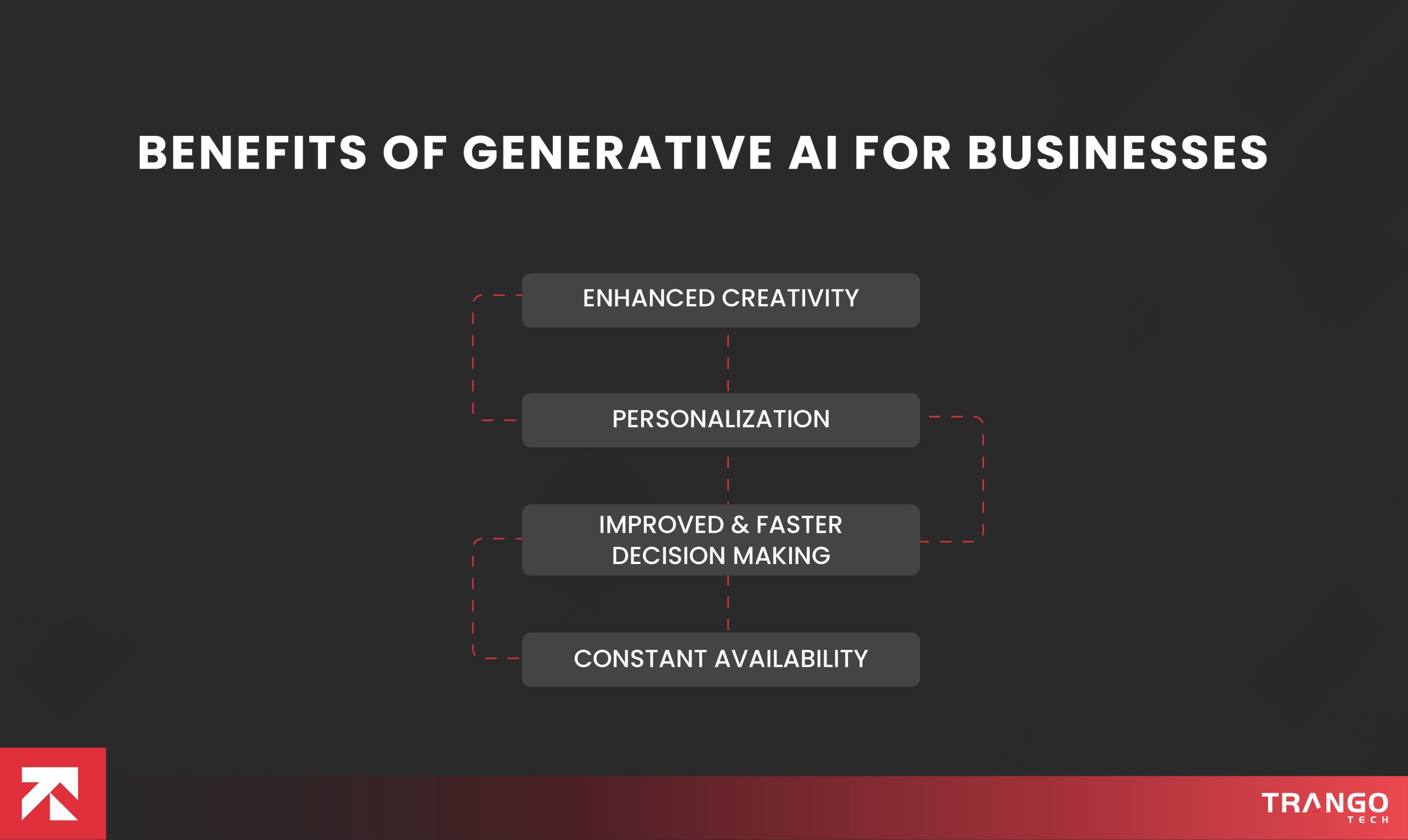
The most obvious and common benefit of generative AI solutions is greater efficiency. Generative AI is set to automate and revolutionize tasks with its enhanced capabilities.
Automating labor-intensive tasks reduces costs and frees up time for employees to invest in more valuable work.
1. Enhanced Creativity:
Gen AI capabilities can improve the efficiency and creativity of any task. It offers automated brainstorming, generating multiple novel versions of content.
These variations in responses help writers, artists, designers, and other creators generate creative ideas.
2. Improved & faster Decision Making:
Generative AI solutions excel at analyzing large datasets, identifying patterns, and extracting meaningful insights. It then interprets the insights, generating hypotheses and recommendations to support executives, analysts, researchers, and other professionals in making data-driven, informed decisions.
3. Personalization:
Utilizing generative AI in applications where recommendations are a crucial part of the application. Generative AI analyzes user behavior, preferences, and history to generate personalized content in real time, resulting in a customized and engaging user experience.
4. Constant Availability:
The best thing about generative AI is that it is available round-the-clock and can work 24/7 without getting tired. It is the best solution for offering customer support chatbots and automated responses.
Challenges, Limitations, and Risks Related to Generative AI
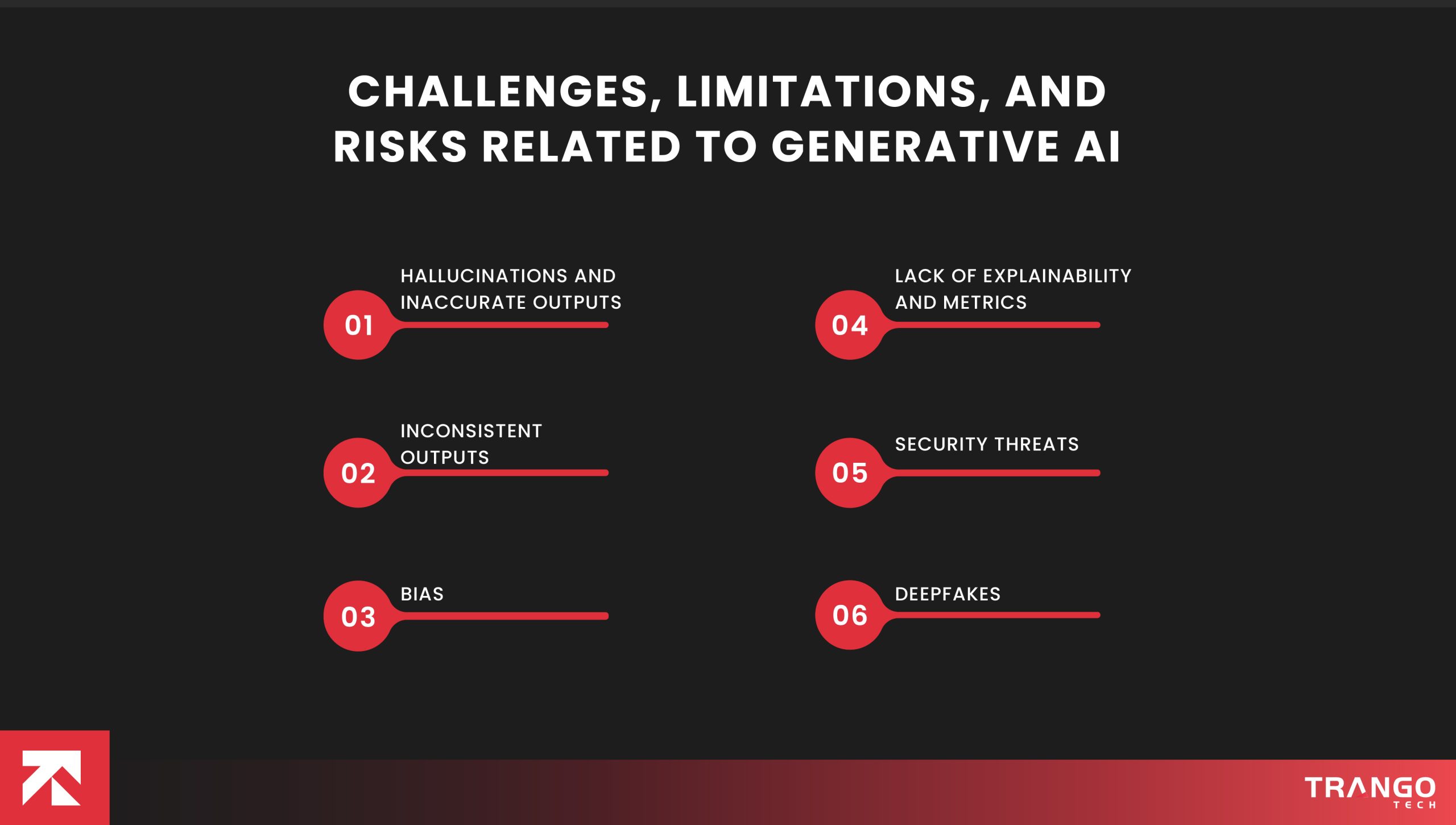
Generative AI has come a long way in a short period of time. Not to ignore the fact that it still has various challenges and risks for developers and users.
Below are the most common issues and how they’re being addressed.
1. Hallucinations and Inaccurate Outputs:
AI often hallucinates; yes, that may sound weird, but it is a fact. It means it produces illogical, nonsensical output. It often creates fictional use cases with quotes and numbers.
Some practitioners have concluded that this is an unavoidable trade-off between accuracy & maintaining creativity.
But to avoid these hallucinations, there’s a preventive measure called guardrails that restrict the model to relevant or trusted data sources.
2. Inconsistent Outputs:
Generative AI is probabilistic; thus, it produces variations in its output even with the same input. But this becomes highly problematic and unacceptable, especially in applications such as customer support chatbots, where consistent output is desirable.
3. Bias:
Training data can be societally biased, leading to bias in generative AI. Even if it learns societal biases from labeled data, external data sources, and human evaluators, it can still generate biased, unfair, and offensive content.
Developers must ensure they provide diverse training data to their generative AI model to prevent biased outputs. They must also create guidelines to prevent bias during training and tuning. They must also regularly evaluate the model’s outputs for bias to assess accuracy.
4. Lack of Explainability And Metrics:
Some generative AI models operate in a ‘BLACK BOX,’ meaning you won’t understand what’s happening internally or how decisions are made.
So, there is a dire need for explainable AI practices and techniques to help practitioners and users understand the processes and outputs of generative models.
5. Security Threats:
Security concerns may arise if sensitive data is used to train generative AI models. There must be proper checks and balances to ensure that generative AI tools produce responses that limit unauthorized access to proprietary information.
Generative AI models can also produce phishing emails, fake identities, and other forms of malware, fooling users into taking actions that compromise security or data privacy.
Developers must be very cautious about the data they input into the model during training or as part of a prompt, so that it does not reveal their own intellectual property (IP) or any other information protected as IP by other organizations.
6. Deepfakes:
Deepfakes are AI-generated hyper-realities, manipulated images, videos, or audio. They mimic the person’s likeness by analyzing footage and voice samples of the real person.
This generative AI activity promotes fraud by allowing fraudsters or creators to make it appear as though they said or did things they never actually did.
It is the most dangerous thing about artificial intelligence to date, as it can damage a person’s reputation within seconds.
How to Adopt Generative AI in Your Business?
Adopting generative AI in businesses requires a structured approach that balances speed-to-value with operational discipline.
When organizations move from pilot to production without a clear strategy, they frequently encounter scaling issues and governance gaps that undermine business value and trust.
Mapping Processes Suitable for Generative AI Automation:
Those business processes that are highly document-intensive and generate large volumes of information.
These types of documentation involve contract reviews, report generation, compliance monitoring, etc.
Inventorying Proprietary Data Sources:
To train or ground AI on internal data, you must evaluate and prepare your information landscape.
Data Mapping: Locate where unstructured and structured data lives across your company. Eg, CRMS, ERPs, shared drives, and project management tools.
Quality and Cleaning: Consolidate the spreadsheets and fix formatting errors so the AI receives consistent information.
Security & Governance: Implement strict data governance frameworks to restrict access by employee role, mask personal information, and prevent the leakage of confidential IP.
Architecture Selection: Determine how you feed this data to the AI model.
The following options are included:
Prompt Engineering: Passing contextual data directly into the chat box.
RAG: Allowing AI to query. Connect your internal, proprietary datasets to a pretrained model dynamically, minimizing hallucinations and keeping data up to date.
Fine-tuning: Customize an existing foundational model specifically on your domain data.
Future of Generative AI in Business:
As we all know, generative AI is becoming more than just a productivity innovation; it’s a core operational engine. It is fundamentally altering core business processes, including decision-making, customer service, and business planning.
It’s not replacing humans; it’s just a myth. It’s just making humans’ tasks easier. It focuses on augmenting staff, requiring organizations to heavily invest in workforce training and AI-driven skill development.
How Trango Tech Can Help You Implement Gen AI?
Understanding generative ai meaning is one thing. Actually building it into your business without wasting months or budget on the wrong approach is another. That’s where Trango tech steps in.
We work with businesses to turn generative AI ideas into solutions that actually run within their operations. It includes custom AI solutions, seamless integrations, and customer support. So you don’t need to become an AI expert. You just need a team that already is one.