How to Build an AI Agent: A Step-by-Step Guide
Building rigid chatbots is just a waste of time. Even Gartner agrees, predicting that 40% of enterprise apps will upgrade to autonomous AI agents. Product managers and founders are moving on to smarter, task-specific AI that actually does the work. Modern AI agents are more like independent team members. You give them a goal, and […]
Building rigid chatbots is just a waste of time. Even Gartner agrees, predicting that 40% of enterprise apps will upgrade to autonomous AI agents. Product managers and founders are moving on to smarter, task-specific AI that actually does the work.
Modern AI agents are more like independent team members. You give them a goal, and they handle the steps, connect to the right tools, and get the job done without constant check-ins. All this without constant human supervision.
For those who want an AI agent to do a good job out in the wild, you really just need four main ingredients. A smart base model, solid memory, handy tools it can use, and the ability to fix its own mistakes.
Regardless of whether you want to build an AI agent for free using visual no-code builders or engineer custom systems, understanding this proven process by our agentic AI development company is paramount.
This write-up covers every critical architecture layer. From base models to memory systems, tools, and orchestration frameworks, we have explained all you need to build your own AI agent.
What is an AI agent? Explained in simple words
Think of an AI agent as a loop that constantly looks, thinks, plans, acts, and reviews. Standard AI just chats back and forth, but an agent takes a goal, uses outside apps, remembers what it did, and fixes its own slip-ups.
For a real-world example, ChatGPT, Gemini, and Claude are a few of the most well-known LLM-based chatbots. They are built with the purpose of just information retrieval.
In contrast, GitHub Copilot, Intercom Fin, and Devin AI are a few good names associated with AI agents.
Below, we have done a quick comparison of AI agents vs. Chatbots for your better understanding:
| AI Agent | Chatbot |
| Receives a broad goal. | Receives a message. |
| Runs in a continuous loop, making choices at every step. | Writes text back and stops after one reply. |
| Uses external apps, APIs, and data. No need for constant human prompts. | Cannot use software tools or browse the live web on its own to finish a task. |
Core Components of an Autonomous AI Agent
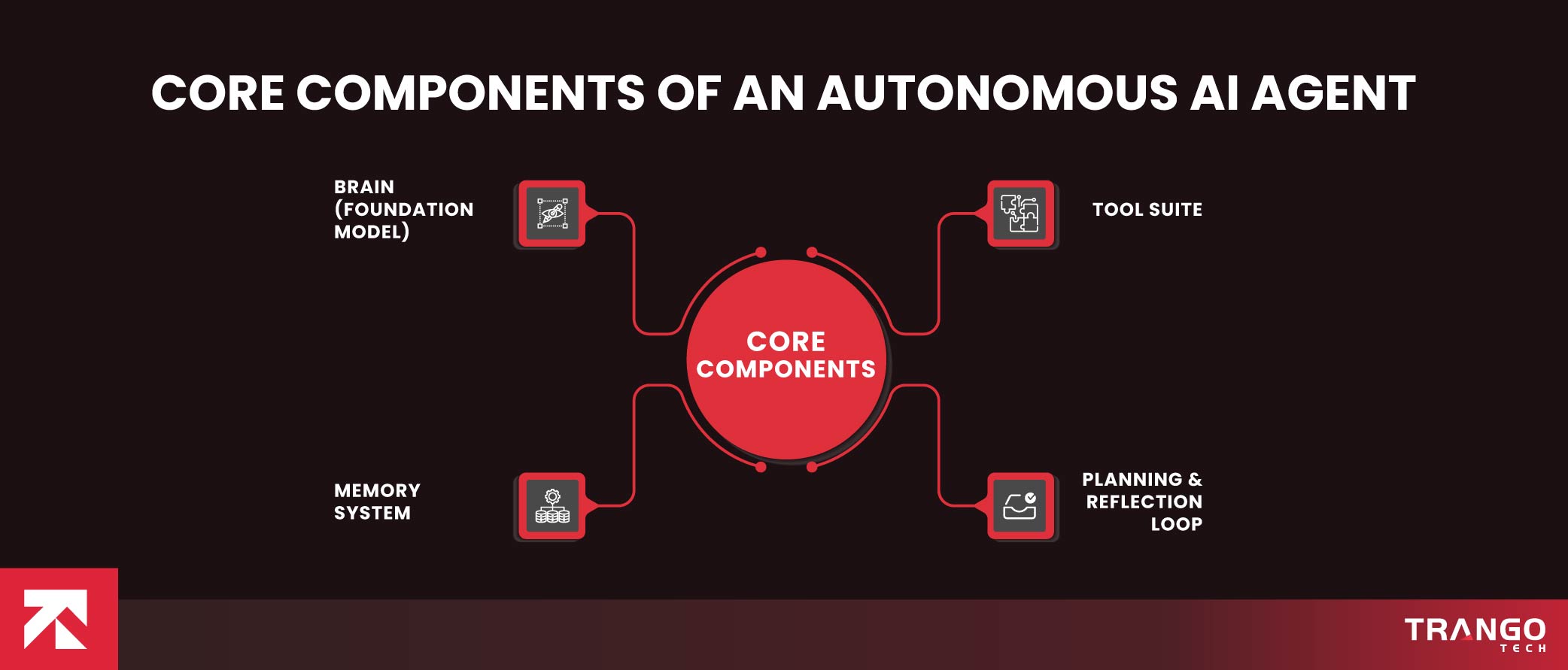
Unlike static code, AI autonomous agents utilize dynamic reasoning, contextual storage, and external capabilities.
In light of that, they can solve complex problems independently through self-correction. So if you are also on a mission to build an AI agent, know that four architectural pillars are non-negotiable.
Those who make the most of these core components will end up highly capable digital workers.
I will start with the foundation first:
-
Brain (Foundation Model)
It serves as the central intelligence engine. Your agents make decisions using this. Without a core reasoning layer, it is nearly impossible for a bot to do a job.
-
Memory System
Your AI agent will require structured memory. This is important because it is where background knowledge is stored.
-
Tool Suite
Tools are what provide AI agents with abstract reasoning and real-world execution. As a result, they manipulate their digital surroundings.
-
Planning & Reflection Loop
Due to immense autonomy, your AI agents will be continuously assessed to judge performance. It then utilizes self-reflection to audit its own outputs.
How to Create an AI Agent from Scratch?
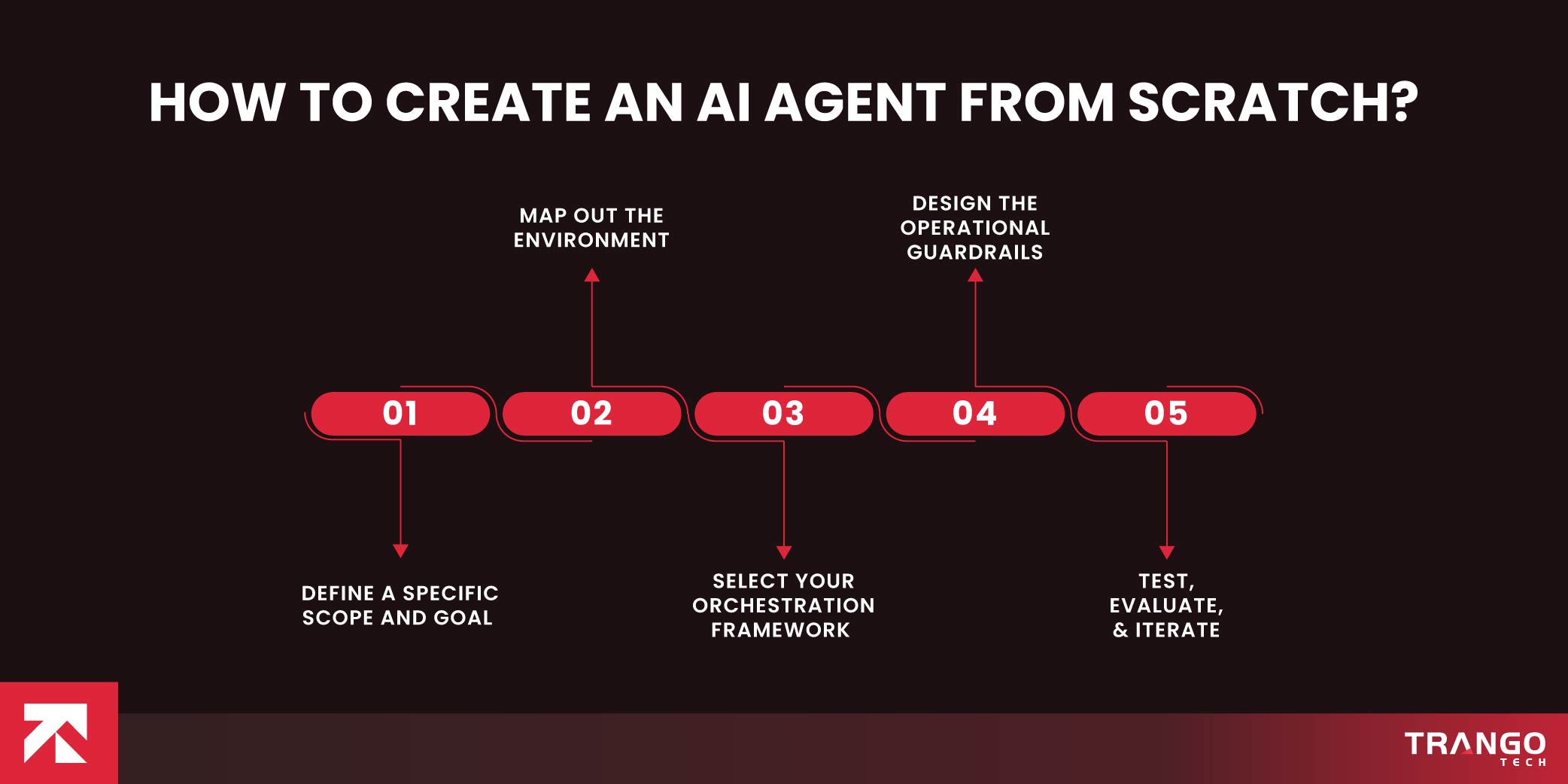
One has to move beyond simple prompt engineering to create an AI agent. This is the only way to come up with a dynamic system capable of planning, acting, and adapting.
If you want to know how to create an AI agent, keep in mind to think outside the box. Ensure your motive is not just to finish it.
Successful implementation relies on a pragmatic approach. It encompasses system design, component selection, operational guardrails, and continuous testing.
Go for something other than a passive chatbot that merely responds to user input. Burn the midnight oil, since the AI agent will be your kind of digital teammate. By itself, it processes high-level goals and executes complex workflows independently.
Want an agent exactly like this? Follow the given easy-to-do steps for an outrageous AI agent now.
Step 1: Define a Specific Scope and Goal
First of all, you should know about a narrow operational scope for your agent. This ensures that individuals don’t end up with a general-purpose assistant.
Having clear goals leaves no stone unturned in terms of ambiguity and execution errors that can arise.
More than that, put your complete focus on avoiding explicit inputs and outputs. All in all, you’d better precisely say what the agent must accomplish.
Step 2: Map Out the Environment
While building your own AI agent, identify every external tool, database, and API it requires.
- Search engine access (e.g., Tavily, SerpAPI)
- Database operations (e.g., PostgreSQL, Airtable)
- Third-party integrations (e.g., Slack, HubSpot, Gmail)
Don’t expect the model to interact with the real world on their own. This is paramount to supplying the exact interfaces the model will use.
Alongside that, pen down all specific REST APIs, web scrapers, database connectors, or messaging platforms.
Step 3: Select Your Orchestration Framework
With 18+ years of tech experience, we always go for a framework that aligns with your model and technical needs.
You should do the same rather than work with trendy ones. Now the ball is in your court. Choose open-source agent frameworks to manage complex multi-step states, task delegation, and conversation loops.
If you prefer a visual, low-code interface, choose workflow platforms that connect components through drag-and-drop.
| AI Agent Frameworks | Best Used For | Framework Style |
| LangChain / LangGraph | Complex, multi-step state machines and production applications | Graph-based state control |
| CrewAI | Multi-agent collaboration with role-playing teams | Task and role delegation |
| AutoGen (Microsoft) | Conversational multi-agent orchestration | Inter-agent conversation loops |
| LlamaIndex | Heavy data-retrieval and document-centric agent workflows | RAG and data indexing |
| No-Code Platforms (n8n, Flowise) | Building production AI agents for free or low-cost visually | Visual node workflow builders |
Step 4: Design the Operational Guardrails
This is the daunting yet most effort-intensive step in your process to create an AI agent.
You should start with comprehensive construction of system prompts. Do it in a way that establishes the persona, operational rules, response formats, and safety boundaries in the agent.
If possible, one should instruct the agent on how to handle ambiguous user inputs. See how it structures function calls, such as demanding valid JSON outputs. Last but not least, handle your tool failures gracefully as well.
At the end of this phase, try to implement proper operational guardrails to protect your infrastructure. There should be a maximum iteration limit.
To prevent infinite logic loops, enforce API rate limiting, and restrict access to high-risk database or execution operations.
Step 5: Test, Evaluate, & Iterate
Finally, when everything is done and dusted, subject your agent to systematic testing.
This basically involves realistic scenarios before pushing it into live environments. See how your AI agent breaks down objectives and executes tool calls.
Other than that, one should take care to ensure that it recovers from API errors and manages context. Measure all your primary operational metrics.
It spans task completion rates, average execution latency, token consumption costs, and failure frequencies. If any problem exists, refine it immediately, tighten tool schemas, and adjust memory retention rules.
How Much Does It Cost to Build an AI Agent?
Before you even ask how to build an AI agent, most of us are very concerned about the pricing. Normally, you should expect to pay anywhere between $ 10,000 and $ 150,000 to build your own AI agent.
Other than that, your final numbers will depend on whether you choose to DIY, configure tools, use a deployment partner, or the complexity.
| Agent Type | Estimated Cost Range | Build Timeline |
| Conversational Chatbot | $5,000 – $20,000 | 3 – 6 weeks |
| RAG Knowledge Agent | $15,000 – $50,000 | 4 – 8 weeks |
| Task / Process Agent | $25,000 – $80,000 | 6 – 12 weeks |
| Multi-Agent / Enterprise System | $100,000 – $400,000+ | 4 – 6 months |
Why Should You Create an AI Agent?
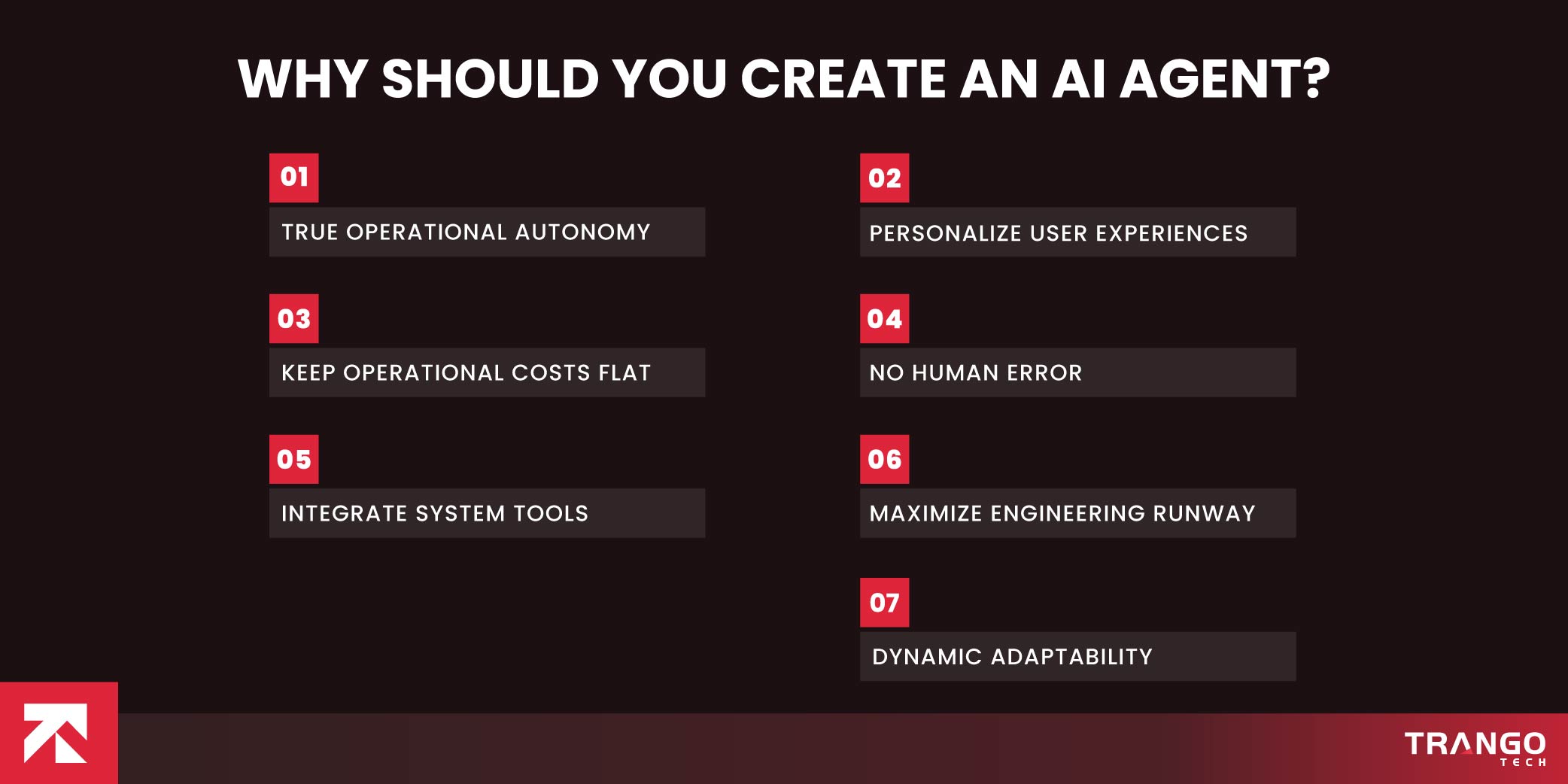
If you are still using a legacy system that follows strict, predefined rules, remember that it only responds to immediate prompts.
Apart from that, AI agents break past these limitations. They do autonomous reasoning, proper planning, and execution.
To make it simple, such autonomous agents evaluate their environment, process information, and make decisions.
Businesses with a tight budget should definitely go for AI agents. Explore several other reasons below that make building your own AI agents worthwhile:
1. True Operational Autonomy
In opposition to AI apps, these intelligent systems do your everyday routines without your approval. This too, with a better success rate than you expect.
Take, for example, your Shopify store that sells perfumes. While you are busy with something urgent, an agent works as a kind of digital assistant. It qualifies income conversions while blocking bugs that can undermine your success.
If you are an early-stage startup or a mid-size firm, having your own AI agent can save you millions annually due to the lack of human oversight.
As a result, you free up valuable internal resources and can later use them for strategic initiatives to grow.
Also read: Learn everything you should know about generative AI development.
1. Keep Operational Costs Flat
Whether it’s management complexity, hiring overhead, or operational expenses, AI agents have you covered.
You can scale infinitely as required without degrading execution quality or increasing headcount costs ahead.
Alongside that, an agentic system processes ten thousand customer requests or data transformations. All this with the exact same consistency and precision as it processes ten.
By deploying AI agents across your core operations, you decouple revenue and product growth from linear headcount growth.
2. Integrate System Tools
This is, so far, the biggest benefit of chatbots that operate within isolated chat interfaces. Given that these agents are directly embedded in your existing systems, things get a lot easier.
Their capability to read and write data to databases is something no one thought of before. It triggers webhooks, queries third-party software, and manages file systems.
Consider all that; we must say that this is gonna be a fully functional operational layer that completes actual work.
3. Dynamic Adaptability
What we have found is that rigid automation mostly breaks in edge cases. Meanwhile, AI agents use large language models to reason through unexpected variables dynamically.
When they fall into a dilemma, the system tweaks strategies in a way better than humans do. While doing that, in case of any error or missing parameter, it self-corrects, attempts alternative routes, or systematically understands context.
Taking all that into account, users receive much more relevant answers. Generic bots here would fail silently or throw a critical error.
4. Personalize User Experiences
Something that sets AI agents apart is that they maintain persistent context before answering. In this way, you get very relevant responses.
For example, when an individual types a prompt for the best books to read, the system learns about what you love first. In contrast, generic setups simply share the list of what’s trending.
Similarly, during the thread, they analyze behavior, historical preferences, and immediate intent to answer.
5. No Human Error
AI has a motive to support human effort. This was never built to replace humans. Your repetitive manual tasks are a bit heavy.
Let’s say if you have to copy data, run code audits, or manage schedule dependencies, there is room for error.
When you do this with AI, there is likely a chance of error. Even more, you save time and capital on repairs.
6. Maximize Engineering Runway
For startups and lean engineering teams, overall development time remains one of the most expensive assets.
Deploy your AI agents to manage background processes, automated testing, or handle tier-one user inquiries.
With autonomous systems, you handle maintenance, monitoring, and operational logistics more easily than ever.
This saves you a lot of time you put into everyday fires and more time shipping core product features. If you are looking for an AI agent tutorial, check out the video below to quickly get started with it.
Challenges You May Face While Building Your Own AI Agents
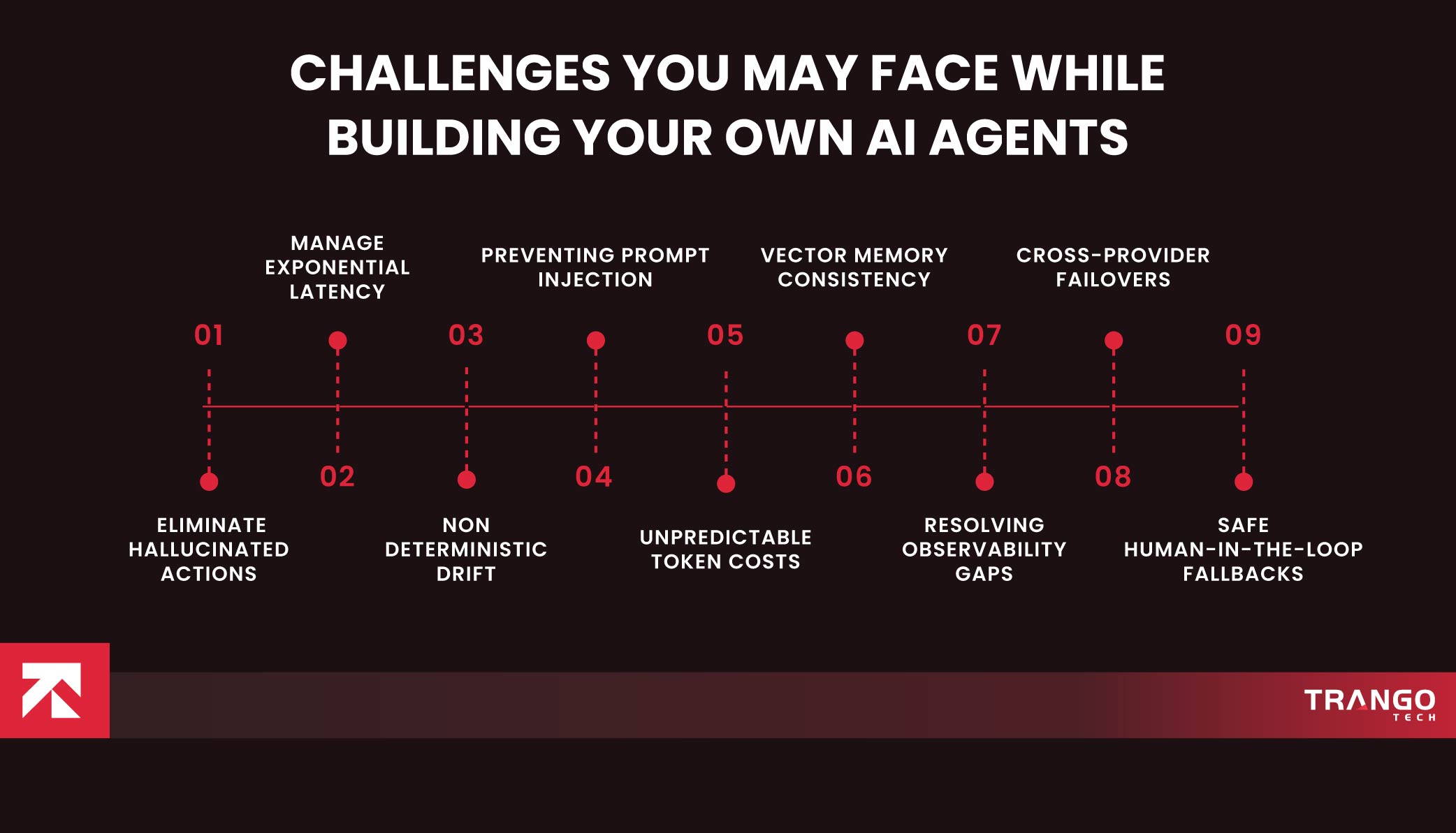
While traditional software executes predictable, deterministic code, nothing is something you might feel a lot.
AI agents operate non-deterministically. They have to make decisions in real time, calling external sources if required. Even more, they understand your context first as well.
This unpredictable nature, along with its benefits, carries its own set of hurdles that are important to address.
When you move your local prototypes to production environments, the following are critical technical obstacles you should address. They span security, state management, latency, and cost efficiency.
1. Eliminate Hallucinated Actions
One of the most challenging things to take care of is when an agent hallucinates. This means that it starts calling non-existent function names and passes malformed or unexpected API responses.
Since your traditional backend servers respond with standard status codes, these tool-use errors often fail silently inside the workflow.
Without strict JSON schema validation, input sandboxing, and output verification, no agent can work reliably.
2. Manage Exponential Latency
Multi-step agentic workflows can compound your latency quickly. When you try multiple vector database searches, they require querying three third-party APIs too.
So every single step you take can take anywhere between one and two seconds. This makes users frustrated and wait an extra 15 to 30 seconds.
Hire AI developers who implement asynchronous tool calling. Ensure they burn the midnight oil for parallelized sub-agent execution and streaming responses.
3. Non-Deterministic Drift
No matter what AI agent you go for, they always seek periodic updates and safety tuning from providers.
If prompt templates and agent instructions worked well, they might not be effective tomorrow.
This is so-called non-deterministic drift. It is how your agents miss edge cases, alter their decision-making logic, or ignore guardrails.
In order to prevent that, you need evaluation pipelines, version-controlled system prompts, and regression test suites.
4. Preventing Prompt Injection
Nothing is perfect. Even the most reputable autonomous agents like Claude Code, Harvey AI, and AutoGPT have vulnerabilities.
This particularly becomes an issue when your existing systems consume untrusted user data or web content.
For example, if you try malicious indirect prompt injections with hidden embedded text, it can also put everything at risk.
What you are supposed to do is protect your agent stack through strict Role-Based Access Control.
If needed, use sandboxed execution environments and runtime input/output guardrails that validate itent before execution.
5. Unpredictable Token Costs
If your AI agent will also go through long-horizon reasoning loops, you should never make it easy for it.
Sooner or later, this is going to lead to historical chat turns, retrieved document chunks, and verbose API payloads.
As a result, you will have a greater token consumption cost per request than you expected. Even more, AI agents hit rate limits during traffic spikes.
For those who want to be cost-sustainable, try aggressive context pruning no matter how much effort it needs.
Hopefully, your existing setup will work as you expect. It should summarize historical message buffers, intermediate reasoning, and proper routing.
6. Vector Memory Consistency
For an AI agent, it is necessary to have persistent memory. This recalls past user interactions to ensure up-to-date responses.
However, managing state across extended workflows is notoriously difficult. Given that those pipelines often introduce semantic noise, they can retrieve stale, irrelevant, or conflicting context.
Those who are up to designing a dependable memory architecture take a structured state store as a starting point.
With memory decay algorithms, clear entity tagging, and explicit context chunking strategies, you will leave no stone unturned.
It ultimately ensures the agent grounds its reasoning in accurate, up-to-date data. No fluff. No assumptions.
7. Resolving Observability Gaps
While your AI agent fails, identifying the root cause is far more complex than you can think.
This breakdown could stem from poor prompt formatting, inaccurate vector retrieval, or model hallucination.
Primarily, all monitoring tools only track server uptime and HTTP codes, leaving you blind to behavioral degradation.
Our experts’ stance is that there is a dire need for AI-native distributed tracing infrastructure in this scenario.
It should log every individual decision node, prompt payload, tool output, and token count step-by-step.
8. Cross-Provider Failovers
Having a sudden rate-limit response mid-workflow breaks the execution chain of your agentic AI bot.
It ultimately leaves end-user requests half-processed or sometimes not processed. During that time, you need an intelligent AI gateway.
The solution to your problem here is to use token buckets, exponential backoff retries, and alternative LLM providers.
Bonus Read: 10 Generative AI Use Cases for Enterprise: A Strategic Guide for US Entrepreneurs
9. Safe Human-in-the-Loop Fallbacks
Granting an AI agent total autonomy over critical business operations introduces immense operational risk.
However, requiring human approval for every trivial action destroys the core speed benefit of building agents.
Here is what the real problem looks like. You have to keep the right balance between both ends.
Ensure that when an agent calculates high confidence in a low-risk environment, it executes autonomously.
Meanwhile, when it encounters ambiguous data, high-value financial actions, or destructive commands, it should not proceed on its own.
It should be trained to halt execution and trigger a human-in-the-loop escalation workflow.
End Note
Building an AI agent means coming up with an autonomous system that reasons, plans, and executes on its own. However, it takes a lot more than just basic prompt engineering and simple API wrappers.
You can go through the complexities of non-deterministic execution, context inflation, and runtime security by DIY. It will likely lead you to nothing but a stalled product, and that too with security vulnerabilities.
For your own powerful agents, you need someone behind it all with solid engineering. One who knows how to build resilient memory stores and human-in-the-loop guardrails.
At Trango Tech, we provide end-to-end Agentic AI development services. We possess deep expertise in artificial intelligence research and practical enterprise software development. This enables us to come up with custom AI agents that deliver immediate operational impact.
With over 20 years of engineering excellence, our team has 280+ senior developers. We have proudly delivered 250+ AI agents in the tech market; we can do it for you too.
If you are really looking to accelerate your time-to-market and do so with a secure, cost-effective, and scalable product, try us now.
Commonly Asked Questions
How is an AI agent different from a standard chatbot?
Your standard chatbot simply generates text responses based on user prompts. In contrast, an AI agent actively sets goals and breaks objectives into smaller sub-tasks. The core difference comes down to how they react to work assigned. AI agents outshine chatbots since they call external APIs, perform real-world actions, and correct their execution errors.
How to Create an AI Agent for Free?
Of course you can. As a matter of fact, production-ready AI agents utilize visual, open-source workflow platforms. For example, you can use n8n or Flowise in this context. Simply using drag-and-drop nodes, such platforms let you connect foundation models, vector databases, and third-party APIs.
What are the best AI foundation models to build agents?
They are ‘high-reasoning’ foundation models, such as GPT-4o, Claude 3.5, or open-source models with high parameter counts like Llama 3, which are better suited to drive agents. These models do very well on structured output formatting (e.g., JSON), choosing the right tool, and planning complex logic.
What are the core components of an architecture of an AI agent?
The four components of an AI agent architecture are the Brain, the Memory System, the Tool Suite, and the Orchestration Loop. All of these collectively are responsible for how to create an ai agent.
What is the role of memory in AI agents?
One of the most important attributes of AI agents is their ability to view the chat history of the conversation they are engaged in and remember what was said for a limited amount of time. They store and recall massive amounts of historical domain knowledge via long-term memory systems such as vector databases (Pinecone, Qdrant), which is called Retrieval-Augmented Generation (RAG).
What are the top open-source AI development frameworks for creating AI agents?
LangGraph (stateful graphs), CrewAI (multi-agent role-playing environment), AutoGen (multi-agent conversation flow), and LlamaIndex (data-centric and document-rich use cases) are the most popular open-source agent orchestration tools. Hope this guide on how to make an AI agent helped.
How can tools enable an AI agent to take real-world actions?
The agent dynamically connects to custom REST APIs, database queries, and code environments presented by the developer in a structured manner. If the agent recognizes a specific need in the planning loop, it creates a structured API request, runs the external tool, and translates the external tool’s output into structured data it can use to complete their task.
How to prevent an AI agent from getting into infinite loops?
You make sure that you don’t have infinite execution loops by setting up operational guardrails in your orchestration layer. These guardrails include restricting the number of times the agent can go through a reasoning loop, setting strict timeouts and API rate limits, and more: restricting the agent from performing high-risk activities until human authorization has happened:
What are the key metrics to evaluate AI agent performance?
Common metrics for measuring the performance of an AI agent are the percentage of tasks performed, the accuracy of the tools used by the agent, how fast the agent corrects its own mistakes, its ability to remember the context, the time it takes to complete an end-to-end workflow, and the number of tokens consumed by the agent per workflow.